Beginner-Friendly Advice
- Do not start with random pieces. Picking up the first piece you see often leads to frustration. A short sorting phase usually saves more time than it costs.
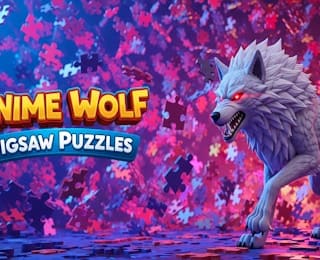
- Use the wolf as your compass. The animal is the focal point and has stronger contrast than many background fragments. If you feel lost, return to the face, ears, or paws.
- Group by color before shape. In an anime illustration, color regions can be more reliable than individual piece contours, especially when many pieces share similar interlocking shapes.
- Work from large zones to small details. Establish the wolf body and the main flower masses first. Tiny highlights and petal edges are easier to place once the surrounding area exists.
- Take breaks before fatigue sets in. Jigsaw puzzles reward fresh eyes. A short pause can help you notice a misplaced red eye fragment or a reversed petal cluster.
- Keep your display clean. Close extra tabs, reduce glare, and use a stable mouse or touch input. Visual puzzles are harder when the screen is cluttered or reflective.
Beginners often assume that speed comes from placing pieces quickly. In a 500+ piece puzzle, speed usually comes from making fewer wrong placements. Slow down during sorting, then accelerate once the major regions are established.
Intermediate and Advanced Strategy
Create a piece map
Instead of making only color piles, imagine the puzzle as a map. The wolf occupies the central and right-side visual weight, while the floral field surrounds it. Assign mental coordinates such as upper-left petals, lower-right fur shadow, or center-face highlights. When a piece looks ambiguous, ask which region of the map it belongs to before testing it.
Exploit high-contrast anchors
The red eyes, dark outlines, and bright petal edges are anchor points. Build small, confident clusters around them. A cluster of three or four verified pieces is more useful than many isolated guesses because it creates a reliable base for neighboring fragments.
Separate similar pinks and purples
The background contains many saturated floral shapes. Sort these by temperature: cool blues and violets versus warm pinks and magentas. Then sort within each temperature by brightness. This two-pass method prevents the common mistake of treating all pink petals as interchangeable.
Use line art as a continuity test
Anime artwork often relies on clean linework. When placing fur or petal edges, check whether the dark line continues smoothly across the seam. A correct fit should preserve the direction and thickness of the line, not just the piece shape.
Batch the hardest regions last
Low-contrast fur gradients and repetitive petals are usually the slowest areas. Leave them until the frame, wolf silhouette, and bold flower clusters are mostly complete. The remaining empty spaces will be smaller, making ambiguous pieces easier to evaluate.
Verify as you grow
Periodically step back from the close-up view. Large assemblies can hide a single wrong piece that distorts an entire region. A quick visual scan for broken lines, odd color jumps, or impossible shapes can prevent costly rework near the end.
Mistakes That Slow Solvers Down
- Forcing pieces into place. If a piece does not sit naturally, it may be shape-compatible but image-incompatible. Digital jigsaw puzzles can sometimes allow near-misses; trust the artwork as well as the contour.
- Ignoring the border. Skipping edge pieces removes the easiest structural guide. A frame gives every interior cluster a reference point and reduces the search space.
- Mixing warm and cool petals. The floral background has many similar shapes. Combining pink, magenta, purple, and blue pieces into one pile creates false matches and wastes time.
- Starting with the most repetitive area. The background may look easy because it is colorful, but repetition makes it harder than the wolf's distinct facial features. Begin where the image gives you clear landmarks.
- Relying only on memory. With 500+ pieces, it is easy to forget where a color cluster belongs. Use sorting zones and reference the full image frequently instead of trusting recall alone.
- Playing through eye fatigue. Subtle fur gradients and small petal edges are hard to judge when tired. Fatigue increases misplaced pieces, which are more time-consuming to find and correct later.
Avoiding these mistakes does not require advanced skill. It mainly requires discipline during setup and a willingness to verify each cluster before expanding it. The solver who sorts carefully usually spends less total time than the solver who places pieces quickly but corrects errors later.