





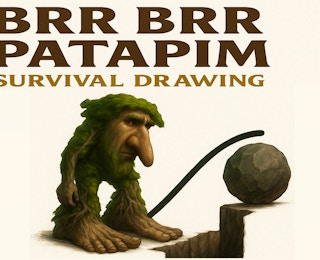
Play Brr Brr Patapim Survival Drawing Online-Brr Brr Patapim Survival Drawing
Similar Games
Controls for Brr Brr Patapim Survival Drawing are built around the act of drawing. The confirmed mechanic is that players defend with doodles, so the essential control is the ability to create marks in the play area. Because the public description does not provide a complete control manual, the most reliable approach is to learn the interface through a short calibration routine before attempting the 50+ challenges.
Primary drawing input
- Mouse or trackpad: Press and drag to draw lines, curves, walls, or shapes. This is the most common input method for browser drawing games.
- Touchscreen: If the game supports touch, a finger or stylus can drag across the canvas to create the same marks.
- Stylus: A stylus may improve precision on compatible devices, especially for angled lines and controlled curves.
Interface actions
Many drawing games include buttons around the canvas for starting a challenge, clearing the board, undoing a stroke, retrying, or continuing to the next scenario. The description does not confirm which of these controls exist, so players should scan the interface before drawing. A useful first step is to locate any visible labels or icons and test them gently.
Calibration routine
- Open the game in a browser window large enough to see the full play area.
- Move the pointer without clicking to understand the cursor position.
- Draw one straight line and one curve in an empty area if the game allows pre-challenge sketching.
- Observe stroke thickness, smoothness, and how quickly the line appears.
- Start the first challenge only after the drawing response feels predictable.
Precision tips
Drawing controls are physical as well as digital. A shaky hand can turn a planned barrier into a useless squiggle. To improve consistency, use a stable surface, keep the wrist relaxed, and draw from the elbow for long lines. On touch devices, brace the device with one hand and draw with the other. If the browser supports zoom, avoid excessive zoom that may cut off parts of the challenge area.
Device considerations
Desktop play usually offers the most precise pointer control, while mobile play may prioritize convenience. If the game is responsive, the core drawing action should remain the same, but the size of the play area and the thickness of strokes may feel different. Players switching devices should recalibrate with a simple test doodle.
Troubleshooting input issues
- If lines do not appear, check whether the browser has blocked the canvas or whether a start button must be pressed first.
- If drawing feels delayed, close unnecessary tabs and ensure the browser is not in a power-saving mode.
- If touch input is inaccurate, try a stylus or increase the size of the browser window if possible.
- If a stroke cannot be removed, look for an undo, clear, or retry control; do not assume one exists.
What is not confirmed
The description does not specify keyboard shortcuts, gamepad support, multi-finger gestures, color palettes, brush sizes, erasers, or pause functions. Rather than inventing a control map, players should treat the live interface as the authority. The constant is drawing: make a mark, watch the result, and adjust.
For how those controls fit into a full session, continue to the gameplay guide below.
The gameplay of Brr Brr Patapim Survival Drawing revolves around a compact loop: observe a sketchy survival problem, draw a defensive response, and evaluate the result. The official description’s promise to “defend with your doodles” gives the loop its direction, while the advertised 50+ challenges suggest that the game tests that loop across many variations.
The core play loop
- Inspect the scene. Identify the vulnerable subject, the moving threat, and the available space for drawing.
- Form a hypothesis. Decide what kind of doodle might interfere with the threat: a wall, a curve, a ramp, a cover, or a guide.
- Draw the response. Place the mark with enough confidence to test the idea.
- Watch the interaction. See whether the doodle blocks, redirects, absorbs, supports, or fails to affect the challenge.
- Refine. Change one element and try again if the game allows repetition.
Defense as a design language
Because the game is framed as survival, defense is not just a theme; it is the design language. A successful doodle usually creates a relationship between three elements: the protected target, the threat, and the drawn intervention. Players who focus on that triangle tend to improve faster than players who draw randomly.
Common drawing roles
While the exact challenge list is not published, the premise and image suggest several probable roles for doodles:
- Blockers: Straight or thick marks that stop movement.
- Deflectors: Angled lines that send an object away from danger.
- Guides: Curves that channel movement along a safer path.
- Covers: Shapes that shield a vulnerable area from above or around.
- Supports: Marks that hold, brace, or create a platform for another object.
These roles are interpretive, not confirmed level types, but they give players a useful vocabulary for experimenting.
Pacing across 50+ challenges
A long challenge set benefits from pacing. Early scenarios are often the best place to learn how strokes behave. Mid-session challenges may require more precise placement. Later challenges may combine multiple threats or less obvious objectives. Instead of rushing to the end, treat each group of challenges as a chance to strengthen a specific drawing habit.
Suggested session structure
- Warm-up: Play two or three easy attempts focusing only on clean strokes.
- Focus block: Choose one challenging scenario and make three deliberate attempts.
- Review: Identify whether failures came from placement, shape, timing, or overcomplication.
- Cool-down: Finish with a simpler challenge to reinforce confidence.
Reading feedback without a manual
In the absence of detailed rules, the game’s feedback is the manual. Object movement, sound cues if present, scene resets, and transition to a new challenge all communicate whether a doodle succeeded. Players should become comfortable with silent experimentation: draw, observe, adjust, repeat.
Avoiding common gameplay traps
- Overdrawing: Adding too many marks can obscure the problem and make failures harder to diagnose.
- Repeating the same mistake: If a line misses, moving it slightly is often more useful than redrawing an entirely new shape.
- Ignoring the target: A defense that looks impressive but does not protect the vulnerable subject is not a win.
- Chasing perfection: Sketchy survival challenges usually reward practical solutions, not artistic polish.
How gameplay connects to improvement
The loop is simple, but mastery comes from making the loop tighter. Faster observation, cleaner drawing, and more precise revision turn trial and error into intentional problem solving. Players who want to develop that skill can continue to the dedicated instruction and strategy pages linked from the main game overview.