








Brr Brr Patapim Survival Drawing Tips and Strategy-Brr Brr Patapim Survival Drawing
Similar Games
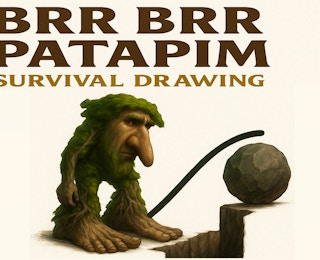

Beginner tips for Brr Brr Patapim Survival Drawing are most useful when they reduce uncertainty. The game asks players to draw under survival pressure, and that pressure can cause rushed scribbles, overthinking, or repeated random attempts. The following habits help new players turn confusion into controlled experimentation.
Tip 1: Protect the target, not the screen
A common beginner mistake is filling the play area with marks. More drawing is not always better. Identify the vulnerable subject and draw only what is needed to affect the threat. Empty space can be just as important as the doodle itself because it helps you see what is happening.
Tip 2: Use the 80 percent rule
Aim for a solution that is about eighty percent sufficient. A nearly correct barrier that can be adjusted quickly is often better than a perfect-looking shape that takes too long to draw. In survival challenges, speed and clarity usually beat polish.
Tip 3: Draw from the threat backward
Instead of starting with the protected object, start with the threat’s path. Ask where the danger will be in the next moment, then draw a mark that intersects that future position. This simple shift improves placement dramatically.
Tip 4: Prefer readable shapes
Readable shapes are easier to evaluate. A straight line, a clean curve, or a simple box tells you immediately what the doodle is supposed to do. Scribbles may feel expressive, but they make diagnosis harder when the challenge fails.
Tip 5: Thicken critical contacts
If a line is meant to stop or deflect something, the contact area matters. Slightly thickening the part of the doodle that meets the threat can compensate for small aiming errors. This is especially helpful on touch screens where precision may be lower.
Tip 6: Avoid changing everything after one failure
When a doodle fails, the temptation is to erase the whole idea and start over. That can prevent learning. Change one element: position, angle, length, curvature, or support. Then compare the result to the previous attempt.
Tip 7: Learn the difference between blocking and guiding
Some challenges may be solved by stopping movement, while others may be solved by redirecting it. Blocking shapes tend to be firm and perpendicular to the threat. Guiding shapes tend to be angled or curved. Recognizing which approach fits the scene is a foundational beginner skill.
Tip 8: Use early challenges as calibration
The first several of the 50+ challenges are not just content; they are a tutorial hidden in gameplay. Pay attention to how strokes appear, how objects react, and whether the game rewards speed or precision. Calibration done well makes later challenges less stressful.
Tip 9: Keep a frustration checkpoint
If two or three attempts feel random, pause. Re-read the scene, identify the target and threat again, and draw the simplest possible mark. Frustration often comes from losing the basic question: what needs defending?
Tip 10: Practice a daily micro-drill
A useful drill is to spend one session focusing only on placement. Do not worry about making attractive doodles. Draw one line per attempt, observe where it contacts the threat, and adjust. This isolates the most important beginner skill.
Beginner checklist
- What is the target?
- What is the threat?
- What path will the threat take?
- What one shape can interrupt that path?
- What single change will I test next?
These tips are designed to stabilize early play. Once they become automatic, players can move from basic survival to more deliberate strategy.
Strategy for Brr Brr Patapim Survival Drawing begins where beginner tips end: after the player can consistently draw a functional mark, the goal becomes choosing the right mark faster and adapting it across the game’s 50+ sketchy challenges. Strategic play is less about drawing more and more about drawing with intention.
Strategic principle 1: Classify the challenge
Before drawing, assign the scenario to a broad category:
- Stop it: The threat must be blocked.
- Move it away: The threat must be deflected.
- Guide it: An object must be routed safely.
- Cover it: A vulnerable area must be shielded.
- Support it: A path, platform, or brace is needed.
Classification narrows the shape palette. A stop-it challenge calls for barriers; a guide-it challenge calls for curves or ramps. This reduces hesitation.
Strategic principle 2: Design the contact point first
Strong strategies start with the exact point where the doodle will meet the threat. If you cannot name the contact point, the drawing is probably too vague. Place the first stroke at the contact point, then extend it only as far as needed.
Strategic principle 3: Use geometry over decoration
Angle, length, and curvature are strategic variables. A line at forty-five degrees may deflect where a vertical line blocks. A long shallow curve may guide where a short steep line fails. Treat geometry as the main language of defense.
Strategic principle 4: Build a personal move library
Experienced players develop a small library of reliable doodles:
- The short blocker.
- The angled deflector.
- The catching curve.
- The overhead cover.
- The ramp-like guide.
- The two-mark brace.
Having familiar shapes ready does not mean forcing the same solution everywhere. It means starting from tested forms and modifying them to fit the challenge.
Strategic principle 5: Optimize retries
When a challenge fails, the fastest path to success is often the smallest useful edit. Strategic players ask: did I miss by a little, or is the entire approach wrong? If the approach is sound, edit the doodle. If the approach is wrong, switch categories.
Strategic principle 6: Manage complexity
As challenges increase in number, complexity can creep in. A strategic habit is to resist adding marks unless each new mark has a clear job. If a second stroke does not improve contact, coverage, or timing, it may be noise.
Strategic principle 7: Adapt to input conditions
Strategy includes physical execution. On a mouse, sharp angles may be easier. On touch, broader curves may be more reliable. A smart player chooses shapes that match their input method, not just shapes that look ideal in theory.
Strategic principle 8: Use failure data
Each failed attempt is data. Record mentally whether the failure was spatial, geometric, temporal, or execution-based:
- Spatial: wrong location.
- Geometric: wrong shape or angle.
- Temporal: drawn too early or too late.
- Execution: shaky line, incomplete stroke, or accidental gap.
This vocabulary makes improvement targeted.
Strategic principle 9: Play for consistency across 50+ challenges
A long challenge set rewards adaptable systems more than memorized answers. Instead of asking for the perfect doodle, ask for a repeatable process: classify, contact, draw, observe, edit. That process scales across varied scenarios.
Strategic principle 10: Know when to simplify
The most advanced move is often the simplest one. If a complex drawing keeps failing, replace it with a crude but direct barrier or guide. Survival drawing strategy values function under pressure. A humble line that works is a strategic victory.
Long-term improvement path
- Master placement.
- Master shape selection.
- Master quick editing.
- Master challenge classification.
- Master calm execution under repeated attempts.
This path turns Brr Brr Patapim Survival Drawing from a series of random doodle tests into a disciplined drawing-defense practice.