







How to Play Solitaire: Simple Beginner Guide-Classic Solitaire
Similar Games

61762545.jpg)

60548019.jpg)
60802768.jpg)


How to Play Solitaire for Beginners
Solitaire is a card game for one player. You need no partner and no opponent. You need only a standard deck of 52 cards. The most popular version is called Klondike, and most people simply call it solitaire. You can play it free in your browser with Classic Solitaire.
The goal is easy to state. Move every card onto four home piles, called foundations. Each foundation holds one suit. Each one starts with an Ace and ends with a King. Finish all four piles and you win the game.
This guide walks you through everything a first-time player needs. You will learn the layout, the core rules, and the correct way to move cards. You will also see the mistakes beginners make and simple tips to win more often.
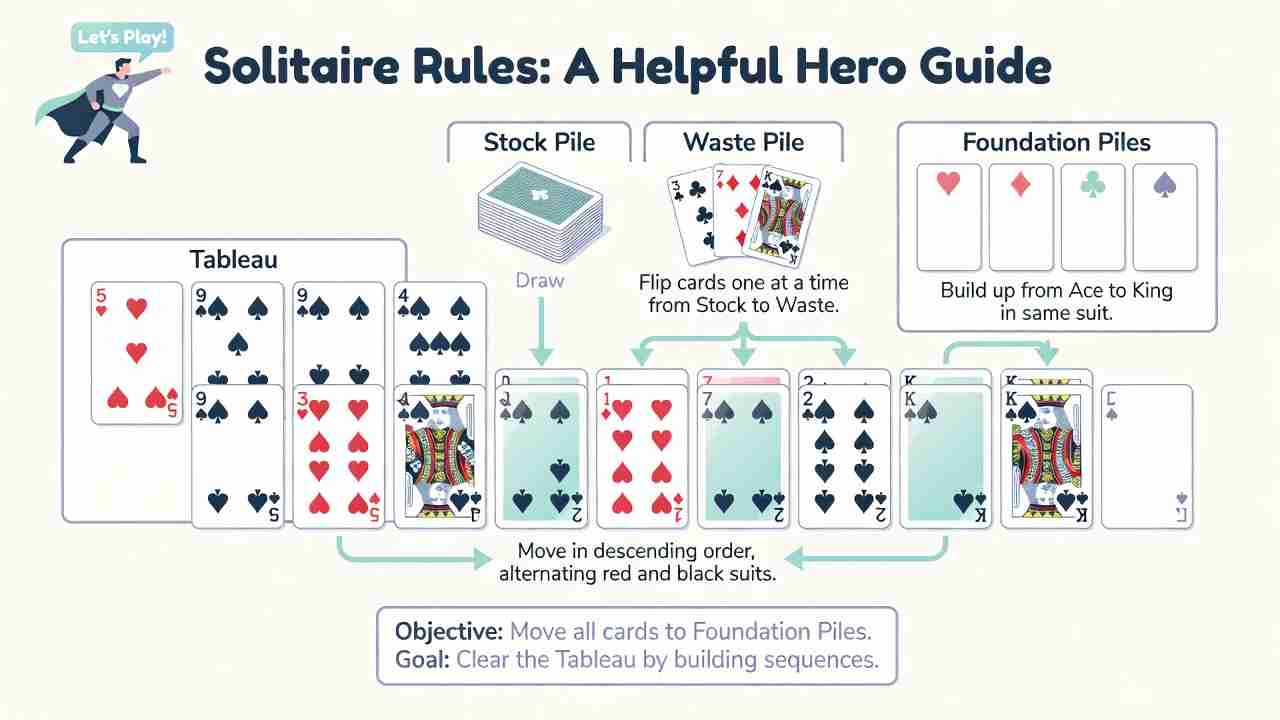
Understanding the Solitaire Layout
A solitaire board has four parts. Learn these names first, because every rule below uses them.
- Tableau: Seven columns of cards in the middle of the board. This is your work area.
- Foundations: Four piles at the top. Cards go here to win the game.
- Stock: The leftover cards, face down. You draw from here when you need help.
- Waste: Cards you already drew from the stock. Only the top card can be played.
The deal follows a fixed pattern. Column one gets one card. Column two gets two cards. Each column adds one more card, up to seven cards in the last column. Only the top card of each column starts face up. Every card under it stays face down. The 24 leftover cards become the stock.
| Pile | What It Holds | Main Rule |
|---|---|---|
| Tableau (7 columns) | Your working cards | Build down in alternating colors |
| Foundations (4 piles) | Cards you have won | Build up by suit, from Ace to King |
| Stock | Leftover cards, face down | Draw from it when you have no moves |
| Waste | Cards drawn from the stock | Only the top card is playable |
Keep this table in mind while you play. It is your quick reference when you feel stuck.
Basic Rules of Classic Solitaire
The rules of classic solitaire are short. Read them once, then learn the rest by playing.
- Tableau piles build down in alternating colors. A red 6 goes on a black 7.
- Foundation piles build up in the same suit. The 2 of hearts goes on the Ace of hearts.
- Only face-up cards can move.
- You may move a face-up card together with all cards stacked on top of it.
- An empty tableau column accepts only a King, or a stack led by a King.
- An empty foundation accepts only an Ace.
- When the tableau offers no moves, draw from the stock.
- The game ends when you win, or when no legal move remains.
Draw 1 or Draw 3: Which Mode Fits You?
Most solitaire games offer two draw modes. In draw 1, you turn one card from the stock at a time. In draw 3, you turn three cards at once, but only the top card can be played. Draw 3 hides more cards, so it is harder.
| Draw Mode | Cards Turned | Difficulty | Best For |
|---|---|---|---|
| Draw 1 | One card at a time | Easier | Beginners learning solitaire rules |
| Draw 3 | Three cards at a time | Harder | Players who want a real challenge |
Pro Tip: Start with draw 1 while you learn the game. Switch to draw 3 only after you can win most draw 1 games.
How to Move Cards Correctly
Moving cards is the heart of solitaire. Follow these steps in order during every turn.
Scan the tableau. Look at every face-up card. Find pairs that fit: one rank apart and opposite colors.
Make the move. Place the lower card onto the higher card. For example, a red 9 moves onto a black 10.
Flip the new top card. After any move, turn the newly exposed card face up. It joins the game at once.
Send Aces home. If you uncover an Ace, move it to an empty foundation right away.
Build foundations up. Add the next card of the same suit: 2, then 3, all the way to the King.
Use empty columns wisely. Only a King can start a new column, so save empty columns for Kings you need.
Draw when stuck. If nothing fits, click the stock. Then check the new waste card for a possible move.
Repeat until the end. Cycle through move, flip, and draw. The game ends when all foundations are complete or no moves remain.
Example Moves That Always Work
- A red 6 moves onto a black 7.
- A black Queen moves onto a red King.
- An Ace of any suit moves to an empty foundation.
- A King, or a stack led by a King, moves to an empty tableau column.
- The top waste card moves to the tableau or a foundation like any other face-up card.
Common Beginner Mistakes
Most new players lose for the same few reasons. Learn these traps and you will avoid them.
- Moving cards without a plan. Every move should reveal a hidden card or free a pile.
- Emptying a column too early. An empty column is useless until you have a King to fill it.
- Ignoring the waste pile. The top waste card is always playable. Check it before you draw again.
- Sending every low card home. Sometimes a 2 or 3 is still needed on the tableau. Think before you move it.
- Drawing from the stock too fast. Drawing can skip cards you need now. Look first, draw second.
- Giving up too soon. Many games that look lost still hide one good move. Scan the board again before you restart.
Warning: Never fill an empty column with just any King. Pick the King that unlocks your best cards. A wasted empty column can end your game.
Quick Tips to Win More Often
These small habits add up. Use them in every game you play.
- Move Aces and Twos to the foundations early.
- Prefer moves that flip a face-down card.
- Play from the tableau before you draw from the stock.
- Keep one empty column possible for a King you truly need.
- Remember which cards are still hidden, and plan around them.
- Practice with draw 1 before you try draw 3.
- Take your time. Solitaire rewards patience, not speed.
Pro Tip: When two moves look equal, choose the one that flips a hidden card. More visible cards always mean more choices.
Ready to test what you learned? Deal a fresh hand of Classic Solitaire and play with this guide open beside you. Every game you finish will make the rules feel natural.
Solitaire Basics: Frequently Asked Questions
Is Classic Solitaire the same as Klondike?
Yes. Klondike is the official name of the game most people call solitaire. If a game says Klondike, Patience, or Classic Solitaire, the rules above still apply.
Can every solitaire game be won?
No. Some deals are blocked from the very start. Most deals give you a fair chance, but a few cannot be solved no matter how well you play. Focus on making the best move each turn, not on winning every hand.
What should I do when I have no moves left?
Draw from the stock and check the new waste card. If the stock runs out, recycle it and go through again. If you still have no legal move after a full recycle, the game is over. Start a new deal and apply what you learned.