







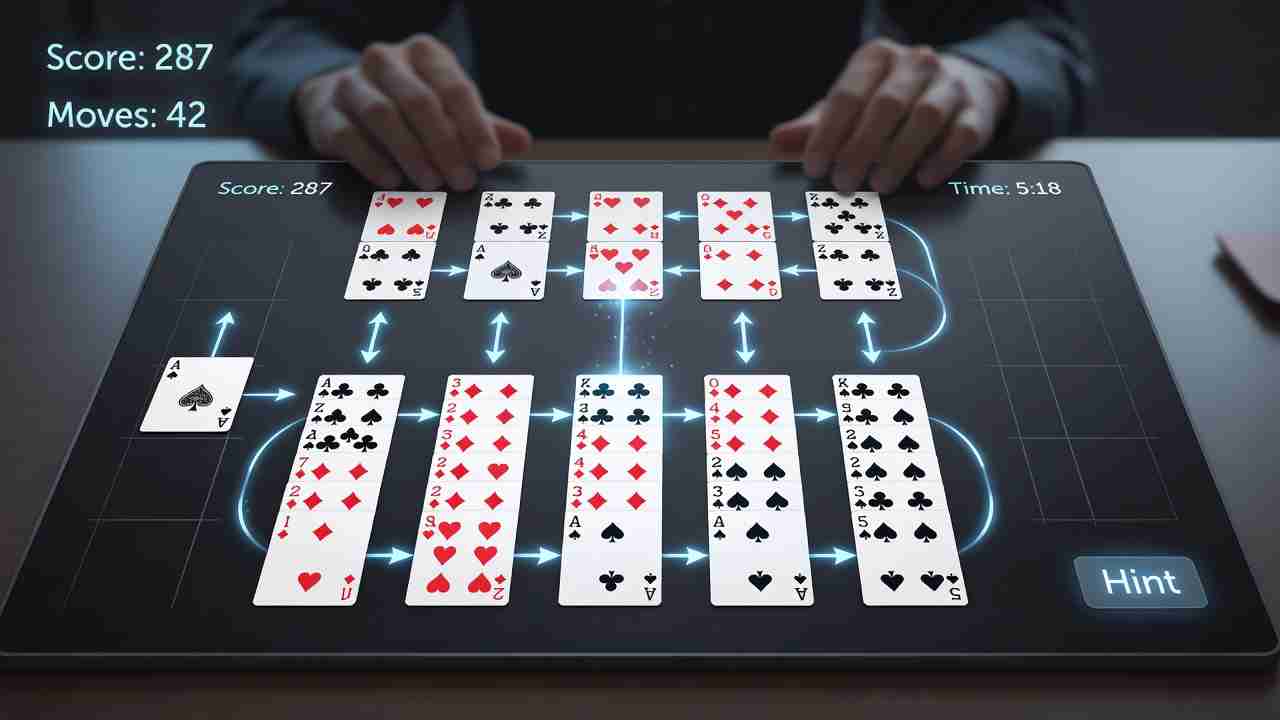
Solitaire Strategy Tips to Win More Games-Classic Solitaire
Similar Games

61762545.jpg)

60548019.jpg)
60802768.jpg)


Classic Solitaire, also called Klondike, looks easy on day one. Yet most players lose far more games than they win. The gap is rarely pure luck. It comes from choice order. Strong solitaire strategy means picking the move that keeps the most options open. It also means knowing when not to move at all.
This guide collects practical solitaire tips for intermediate players. You already know the rules. Now you want to learn how to win solitaire more often. Below you will find clear solitaire tactics for hidden cards, empty columns, the stock pile, and the foundations. Every idea applies to the standard deal you get in Classic Solitaire. Read the full guide once. Then test one tip at a time in your next games.
Use this turn routine until it feels automatic. It is the backbone of any winning classic solitaire strategy.
Scan the tableau for any move that flips a face-down card. Take the best one.
If none exists, look for a move that frees a card you need from the waste pile.
If none exists, check whether emptying a column lets you place a ready King.
If none exists, draw from the stock. In draw-three, note which cards you pass.
After every draw or move, re-scan the tableau before you touch the stock again.
Send cards to the foundations only when the tableau still stays flexible.
Prioritize Face-Down Cards
Face-down cards are the hidden half of your game. Each one blocks a card you cannot see or use. A column with five face-down cards holds five unknowns. That column is your biggest problem and your biggest chance.
Good players ask one question before every move: which option reveals a hidden card? If two moves look equal, choose the one that flips a card. If both flip a card, choose the move that digs into the longest face-down pile. Revealing cards early gives you more choices later. More choices mean more wins.
- Always prefer a move that turns up a face-down card over a move that only reshuffles face-up cards.
- Work on the column with the most face-down cards first. It hides the most information.
- Never bury a useful face-up card just to make a tidy stack. Tidy is not the goal. Options are the goal.
- Before you empty a column of face-up cards, check what the freed space actually buys you.
- If a move reveals nothing and frees nothing, skip it unless it saves a card you need.
Pro Tip: Count the face-down cards in each column at the start of the game. Attack the tallest pile first, and keep attacking it every turn you can.
Manage Empty Columns Wisely
An empty column is a power slot. Only a King can fill it, and a King on open space can host a long alternating run. That makes empty columns valuable. It also makes them dangerous. An empty column with no King in reach is just dead space.
Do not clear a column just because you can. First confirm you hold a playable King. The King may sit face-up in the tableau or wait in the waste pile. If no King is reachable, keep the column partly filled. A half-empty column still catches cards. A fully empty one catches nothing but a King.
Choosing the Right King
When you have two Kings ready, compare them. Place the King that unlocks the most hidden cards behind it. Also look at color. Tableau stacks alternate red and black. Check which Queens you already hold face-up. Pick the King color that matches the Queens you can actually reach. A King with no future Queen is just a parked card.
- Create an empty column only when a King is one move away.
- Prefer Kings that free face-down cards when they move.
- Match King color to the Queens visible in your tableau or waste.
- Use empty columns as temporary storage during long rearranges, then refill them fast.
Pro Tip: In draw-three games, track which Kings are buried deep in the stock. If all four Kings are still hidden late in the deal, treat empty columns as storage, not as King homes.
When to Draw from the Stock
The stock is your reserve, but drawing too early wastes information. Every tableau move you make first can change which stock cards you need. Exhaust useful tableau moves before you draw. Then draw with a purpose, not out of habit.
Timing matters most in draw-three mode. There you flip three cards at once, and only the top card is playable. Passing cards in the wrong order can lock a card you need for a full cycle. Slow down near the end of each pass.
Draw-One vs Draw-Three
| Factor | Draw-One | Draw-Three |
|---|---|---|
| Difficulty | Milder, friendlier to learning | Harder, far more blocked cards |
| Skill vs luck | Skill shows fast | Luck of order matters more |
| Typical win rate | Higher for trained players | Lower, even for experts |
| Key tactic | Delay draws until tableau moves run out | Track pass order to unlock buried cards |
| Best for | Building core solitaire strategy | Testing advanced solitaire tactics |
- Finish every free tableau move before touching the stock.
- In draw-one, a full pass is cheap. Use passes to scout, then plan the second pass.
- In draw-three, memorize the order of each triple. One wasted play can reorder the whole waste.
- Never draw out of boredom. A draw is a decision, not a pause button.
Pro Tip: In draw-three, if playing the top waste card changes which cards you will see next pass, weigh that change first. Sometimes skipping a good play now unlocks two better plays later.
Build Foundations Safely
Foundations feel like progress, and they are. Yet sending cards up too fast can strip your tableau of working cards. Aces and twos are always safe to move. They can never help a tableau stack. After that, pause and think.
Mid-rank cards like fives, sixes, and sevens do real work in the tableau. They hold alternating runs together. If you ship every card to the foundations the moment it becomes legal, you may lose the very card you need to move a stack. Balance speed with flexibility.
- Move Aces and twos to the foundations immediately, every time.
- Before moving a three or higher, ask if any tableau stack still needs it.
- Keep foundations balanced. One suit racing ahead can block cards of other suits.
- Leave at least one card of each color in play when you can, so alternating stacks stay alive.
- Near the endgame, reverse course: empty the tableau into the foundations as fast as legal.
Pro Tip: When a card can go to a foundation or stay in the tableau, count the moves each choice creates. Pick the choice with more moves, not the one that looks cleaner.
Practice Better Solitaire Habits
Strategy only sticks with repetition. Short, focused sessions beat long careless marathons. Play with intent, review your losses, and keep your settings stable so your skill compounds.
- Play the same variant for at least a week. Pattern memory grows faster than raw talent.
- After each loss, replay the last ten moves in your head. Find the first move that cut your options.
- Limit undos to one per game. Unlimited undos teach nothing.
- Track your win rate per variant. Numbers show which tips actually work for you.
- Warm up with draw-one, then train with draw-three to sharpen order tracking.
- Queue a daily round of Classic Solitaire and apply only one new tip per session.
A Simple Weekly Plan
- Days one and two: focus only on flipping face-down cards.
- Days three and four: focus only on empty columns and King placement.
- Day five: focus only on stock timing.
- Days six and seven: play normally and compare your win rate to last week.
Small habits stack up. Within a few weeks, the turn routine will run in your head without effort. That is when your win rate starts to climb for good.
Frequently Asked Questions
How do I win solitaire more often?
Follow a fixed turn routine. Flip face-down cards first, free waste cards second, and draw last. Most losses come from early stock draws and rushed foundation moves. Slow down the first ten moves of every game and your win rate will rise.
Is solitaire a game of skill or luck?
Both. The deal sets your ceiling, but your choices decide how close you get to it. Skilled players win far more of the winnable deals and steal a few tough ones with perfect play. That gap is where solitaire strategy pays off.
Should I empty a column even without a King ready?
Usually no. An empty column only accepts a King. Without one in reach, the space sits idle and you lose a staging column. Hold the column until a King is one move away, then clear it in a single turn.