





How to Play Cute Cow Jigsaw Puzzles-Cute Cow Jigsaw Puzzles
Similar Games
The core goal of Cute Cow Jigsaw Puzzles is straightforward: turn a scattered set of puzzle pieces into a complete cow-themed picture. As a jigsaw-category game, it asks players to use shape recognition, color matching, and spatial reasoning rather than reflexes or combat. Completing a puzzle means every visible gap is filled and the image reads correctly as a whole.
The description mentions more than 50 bovine challenges, so the longer-term goal is to work through a collection of cow-themed images. The available information does not specify a scoring system, timer, star rating, or competitive leaderboard, so players should not assume those systems exist. The satisfaction comes from completion itself and from progressing through the charming puzzle set.
Understanding this goal helps set expectations. The game is not about defeating opponents or managing resources; it is about patiently reconstructing an image. That makes it well suited for casual sessions, short breaks, or relaxed play where the player can focus on visual details.
This focus matters for search intent. Players looking for action mechanics, multiplayer battles, or narrative campaigns will not find those elements described here. Players looking for a calm visual assembly task will find the premise aligned with their expectation.
Exact controls are not listed in the supplied description, but browser jigsaw games usually let players move pieces with a pointer or finger. On a desktop, that commonly means clicking and dragging a piece to a new location. On a touchscreen, it usually means tapping and sliding. The correct approach is to watch the player's on-screen cues and test a piece in a likely position.
When handling pieces, look for three signals: shape compatibility, color continuity, and image alignment. A piece may fit physically but still be wrong if the cow pattern does not line up. Conversely, a piece that looks right in color may need rotation or repositioning if the game supports orientation changes. Rotation is not confirmed in the metadata, so only use it if the interface clearly provides it.
Place pieces carefully and avoid forcing them. Most jigsaw players give feedback when a piece is correct, such as snapping into place or locking. If the game does not provide obvious feedback, compare the assembled section with the reference image before continuing.
Input precision is important in jigsaw games. Small pieces close together can lead to accidental moves, so players should pick up only one piece at a time and place it deliberately. If the interface supports selecting a piece before dragging, use that pause to verify the target area.
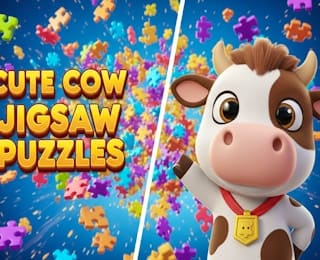
The cow theme creates useful visual landmarks. The promotional image shows a friendly cartoon cow with brown and white areas, a pink snout, large eyes, and a yellow bell on a red strap. Those elements can divide a puzzle into recognizable zones: head, body, bell, background, and decorative border pieces.
Background areas are often easier to start with because they may share similar blue tones or colorful confetti-like shapes. Foreground cow parts are more distinctive because the boundary between brown and white patches creates clear edges. The bell and strap provide small, high-contrast targets that can anchor nearby sections.
Use these clues to sort pieces mentally before placing them. A piece with a curved brown edge may belong near the cow's body outline. A piece with pink and white may belong near the snout. A piece with mostly blue may belong in the background. This reduces trial and error and makes the puzzle feel more manageable.
Another useful clue is negative space. Areas around the cow may contain simple color fields or repeating decorative fragments. These can be less distinctive than the face, but they are often easier to place once the main subject is anchored. Balancing foreground and background attention prevents the puzzle from stalling near the end.
A reliable completion flow begins with observation, then sorting, then construction. First, view the completed image if the player shows one. If not, study the partially revealed picture and note major color regions. Second, separate obvious edge pieces from interior pieces. Third, build or reinforce the outer frame if the puzzle layout makes that practical.
- Inspect the full target image and identify major zones such as cow body, face, bell, and background.
- Collect edge and corner pieces, if they are visually distinguishable.
- Place corner pieces first, then connect edge segments to form a stable border.
- Fill high-contrast interior areas, such as the snout, eyes, bell, and brown patches.
- Use remaining background pieces to close gaps and check for inconsistencies.
After each section is placed, step back visually. Small mistakes are easier to catch before they spread. When the final pieces go in, the completed cow image should appear continuous, with no empty spaces or mismatched patterns.
An alternative workflow is interior-first. If the border is not obvious, build the cow's face or bell area and expand outward. This is especially effective in cartoon puzzles where the subject has bold outlines. Choose the method that matches the visible piece distribution rather than following one rigid rule.
Beginners often try to solve a jigsaw puzzle by grabbing random pieces and testing them everywhere. A calmer method works better. Start by scanning for pieces with straight edges, unique colors, or obvious parts of the cow. These pieces provide anchors. Once a few anchors are placed, neighboring pieces become easier to judge because their surroundings are constrained.
Work from the outside inward when the frame is clear, but switch to distinctive interior features when the edges are ambiguous. Cute cow art usually has strong interior landmarks, so the face and bell can be just as useful as the border. Grouping similar pieces, even loosely, helps prevent repeated searching.
Patience matters. If a piece seems not to fit, leave it aside and continue elsewhere. Returning later with more of the picture assembled often reveals the correct spot. The goal is steady reduction of uncertainty, not brute-force placement.
Beginners can also practice by naming regions aloud or mentally: left ear, bell strap, lower body, upper background. Verbal labeling strengthens spatial memory and reduces random searching. Over several puzzles, this habit helps players recognize common jigsaw patterns more quickly.
Some issues are gameplay-related, while others are technical. If a piece will not stay in place, check whether it is actually aligned with neighboring colors and shapes. A piece can look close but still be one position off. If the game supports snapping, a correct piece should settle cleanly; if it does not, re-evaluate its location.
If controls feel unclear, pause and observe the interface. Look for highlighted pieces, cursor changes, or instructional icons. The supplied description does not document special buttons, so the player's own UI is the authority. Avoid assuming hints, undo, zoom, or rotate exist unless they are visibly offered.
Technical trouble may come from the browser rather than the puzzle. Slow loading, stuttering, or unresponsive drags can sometimes improve by refreshing the page, closing other tabs, updating the browser, or switching to a more stable network. Because the game is delivered as an online embed, connection quality can affect the experience. For access-specific questions, see the FAQ page.
If the puzzle image itself is confusing, reduce the scope. Focus on one small region instead of the entire board. Completing a local cluster creates new reference edges and makes adjacent pieces easier to evaluate. This region-locking technique is useful when the colorful background overwhelms the cow details.