






Cute Cow Jigsaw Puzzles Tips-Cute Cow Jigsaw Puzzles
Similar Games
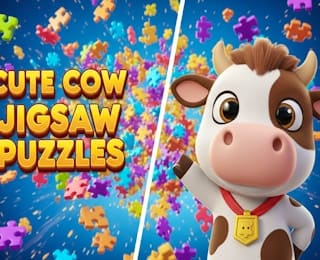
Edge pieces are often the fastest way to tame a jigsaw puzzle. Look for fragments with one straight side, two straight sides, or a corner shape. In a cow-themed image, the outer boundary may include background color, decorative piece shapes, or parts of the cow silhouette, so examine both the straightness of the piece and the artwork on it.
Build the frame only if it helps your workflow. Some players prefer a complete border because it defines the puzzle area. Others find that interior landmarks are stronger in cartoon images. If the edges are ambiguous, switch to obvious features such as the eyes, snout, or bell.
When placing edge pieces, check neighboring colors. A straight edge with blue background may belong on an outer side, while a straight edge cutting through a brown patch may belong along the cow's contour. The frame is a tool, not a rule.
If the puzzle has many similarly colored border fragments, place the most distinctive corners first. Corners reduce ambiguity because they usually have two straight edges. From there, extend along one side at a time instead of scattering attention across the whole perimeter.
Color sorting reduces visual noise. Before placing many pieces, separate them into loose groups: white cow areas, brown patches, pink snout tones, yellow bell pieces, red strap pieces, and background colors. You do not need perfect piles; even rough grouping saves time.
Cute cow art often uses high-contrast boundaries. The line between a brown patch and white fur is a powerful clue. Pieces that contain that transition should be kept near other patch-boundary pieces. Similarly, the bell and strap are small but distinctive, making them excellent anchors.
Background pieces can be trickier if they share similar blue or multicolor patterns. Sort them by dominant hue and any unusual shapes. If the background contains confetti-like puzzle graphics, look for matching clusters rather than relying on color alone.
Avoid over-sorting. Creating too many tiny piles can slow play, especially on a small screen. Aim for broad categories first, then refine only when a group becomes too large to scan comfortably.
Pattern matching goes beyond color. Study how lines curve, how shapes repeat, and where image details interrupt a flat area. The cow's eyes, nostrils, ear edges, and bell outline all create pattern breakpoints that can identify correct neighborhoods.
Use continuity checks. A piece may have the right color but the wrong line direction. If a brown patch edge should curve upward, a piece with a downward curve probably belongs elsewhere. Let the artwork guide placement, not just the piece silhouette.
When several pieces look similar, compare them against already placed neighbors. A small difference in shading, outline thickness, or background speckle can be decisive. Pattern matching becomes easier as more of the image is locked in.
For repetitive background areas, look for rare markers: a brighter splash, a darker shadow, a unique curve, or a partial piece shape. These small anomalies can act as waypoints when the overall color field is uniform.
Jigsaw puzzles reward steady attention more than rushed energy. If you feel stuck, stop testing random pieces and scan for a new anchor. A short pause often reveals an obvious edge, color cluster, or pattern line that was missed during hurried play.
For a collection of 50-plus challenges, pacing matters across sessions. Completing one puzzle well is more satisfying than abandoning several halfway. If fatigue sets in, close the browser cleanly and return later. Because progress saving is not specified, avoid assuming unfinished work will persist.
Celebrate small wins. Finishing the cow's face, completing the bell area, or closing a background corner are useful milestones. They maintain momentum and make the final assembly feel less overwhelming.
Set a realistic session goal. One completed puzzle can be a full achievement, especially for beginners. If you want longer practice, choose a quiet time and limit distractions. Jigsaw focus improves when the player is not multitasking.
One common mistake is ignoring edges entirely. Even when interior features are tempting, a few boundary pieces can provide structure. Another mistake is forcing pieces. If a placement feels wrong, it probably is; jigsaw fit should be guided by shape and image continuity, not pressure.
Players also often mix similar background pieces. In bright cow puzzles, blue areas and colorful decorative fragments can look alike from a distance. Bring pieces closer to the target area and compare neighboring patterns before committing.
Do not neglect the reference image. If the player shows the completed picture, use it often. If it is not visible, reconstruct major zones from memory and placed pieces. Losing sight of the target image is a fast way to create plausible but incorrect assemblies.
Finally, do not assume undocumented helpers exist. If the description does not confirm hints, undo, rotation, or zoom, rely on visible controls. When in doubt, consult the how-to-play guide for baseline mechanics and the FAQ for unknowns.