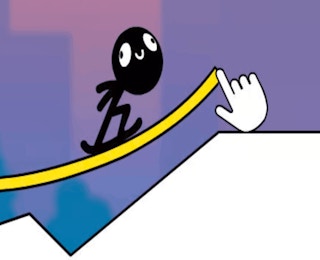
Strategy in Draw Surfer is about route planning. Because the surfer follows your drawing, the best solution is often the one that gives the physics the easiest job. Rather than asking where the shortest line goes, ask where the most controllable line goes.
Core strategic principles
- Predictability beats speed.
- Smooth transitions beat sharp corrections.
- Simple routes beat decorative ones.
- Local fixes beat total redesigns.
A strong strategy begins with identifying the level's critical bottleneck: the obstacle or slope most likely to cause failure. Design the rest of the path to deliver the surfer into that bottleneck in a stable state. This turns each course from a scribbling challenge into a solvable routing problem.
The game's challenges come from combining drawing precision with physics uncertainty. Terrain, obstacles, and momentum create problems that cannot be solved by a single universal line.
- Terrain variation: slopes and uneven ground require different path angles.
- Obstacle placement: hazards force detours and careful clearances.
- Momentum management: the surfer may need speed to cross sections but control to land safely.
- Precision drawing: small input errors can become large ride errors.
Each challenge rewards planning. The player who studies the course before drawing usually outperforms the player who sketches impulsively. The most difficult moments are often transitions, where the route must change direction or elevation without shocking the surfer.
Although specific level details are not necessary to understand the game, progression generally follows a puzzle-learning pattern. Early courses teach basic path shaping, while later challenges demand more refined control over curves, slopes, and obstacle avoidance.
Skill progression
- Learn to draw stable, continuous routes.
- Practice handling simple slopes and turns.
- Combine multiple path features in one run.
- Optimize routes for tighter obstacle windows.
- Develop consistent execution under pressure.
The most effective way to progress is to treat each failed attempt as data. Instead of repeating the same sketch, adjust one parameter and observe the result. Over time, this builds an intuitive sense of how line shape affects surfing behavior.
Expert play focuses on reliability and efficiency. At this stage, the question is not whether a route can work, but whether it works consistently with minimal risk.
Design for failure points
Identify the section most likely to fail and reinforce it with a smoother entry, a safer angle, or a shorter exposure to hazards.
Use minimal viable geometry
Extra path length adds opportunities for error. Expert routes often look simpler because every segment has a clear function.
Master cursor control
Precise drawing is a mechanical skill. Practice steady arcs, controlled movements, and consistent stroke direction.
Iterate like a tester
Change one variable per attempt: angle, length, curvature, or endpoint. This makes improvements measurable rather than accidental.
Expert strategy turns the game from a doodling challenge into a repeatable engineering exercise, where the best path is the one that survives physics with the least variance.