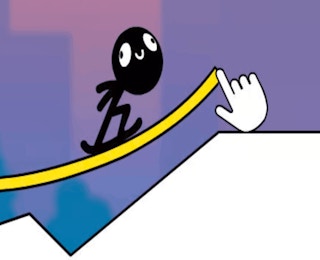
New players often focus on connecting the start to the end as quickly as possible. In Draw Surfer, the fastest route is rarely the safest one. Begin by prioritizing smoothness and control.
- Draw slowly: steady strokes create cleaner lines.
- Use gentle curves: avoid sharp corners that can destabilize the surfer.
- Watch the terrain first: identify obstacles before placing the first mark.
- Keep the path simple: extra loops and unnecessary segments increase risk.
- Test short sections: if a level feels difficult, focus on one tricky transition at a time.
A good beginner mindset is to make the surfer's ride predictable. Once basic routes feel stable, you can start optimizing for more difficult obstacles and tighter spaces.
Most early failures come from drawing habits rather than a lack of understanding. Recognizing these mistakes can speed up improvement.
- Jagged lines: uneven strokes create an unstable surface.
- Overcomplicated paths: too many bends make the route harder to predict.
- Ignoring momentum: a flat or downward section may be needed to carry the surfer forward.
- Drawing directly into obstacles: the path must account for hazards, not just the visual gap.
- Rushing the sketch: a hurried doodle often fails under physics simulation.
If a run fails, do not immediately redraw the same idea. Change one variable at a time, such as the entry angle, curve radius, or endpoint position. Isolating the cause makes each retry more useful.
Once basic routes are consistent, advanced play focuses on efficiency and control under pressure. The goal is not only to finish, but to finish with a route that handles terrain confidently.
- Plan the exit angle: how the surfer leaves a slope often matters more than how it enters.
- Use arcs to absorb impact: rounded transitions reduce sudden changes in direction.
- Balance speed and safety: faster routes can clear gaps, but they reduce reaction margin.
- Build confidence zones: place stable sections before difficult obstacles.
- Refine, do not replace: small edits to a working path are often better than a complete redesign.
Advanced players treat each level as a physics diagram. The drawing is a solution, and every curve should have a purpose rather than serving as decoration.
This guide focuses on how to practice effectively rather than the basic rules. Improvement in Draw Surfer comes from repeatable observation and controlled experimentation.
Observe before drawing
Scan the full course first. Note where the surfer starts, where obstacles cluster, and which terrain features force a change in direction. A quick mental preview prevents wasted strokes.
Draw with intent
Each segment should solve a local problem: climb, glide, turn, or land. Avoid drawing a single vague line and hoping the physics engine fixes it.
Review failures precisely
When a run fails, identify the exact moment: was it a sharp corner, a weak climb, or a bad landing? Adjust that section only, then test again.
Build cursor control
Smooth drawing is a physical skill. Practice steady movement, especially on long curves and tight transitions. Better input control leads to more reliable routes.
Following this loop turns random attempts into deliberate progress and helps build repeatable habits.