







Vita Freecell Mistakes That Block Wins-Vita Freecell
Similar Games

61762545.jpg)

60548019.jpg)
60802768.jpg)


Why Good Players Still Lose at Vita Freecell
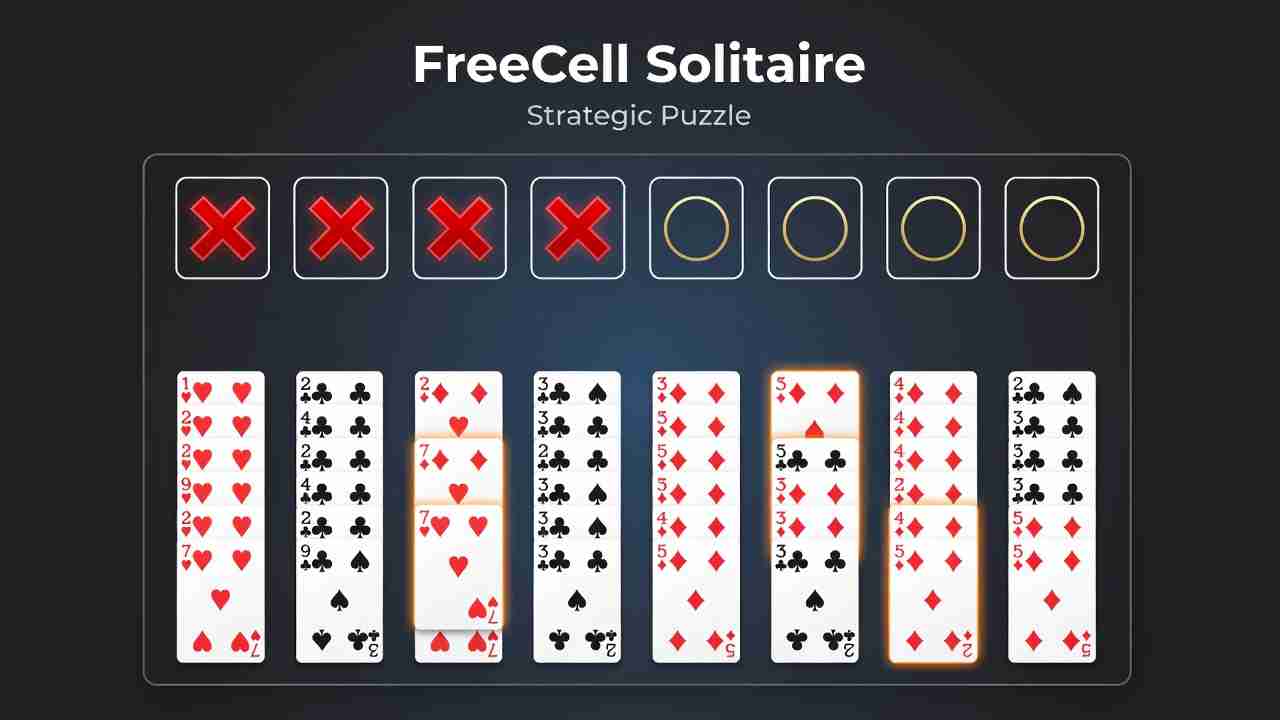
FreeCell looks calm. Every card is face up. Most deals can be won. Yet players still get stuck. Why? Because FreeCell punishes small errors. One careless move can lock a card for the rest of the game.
In Vita Freecell, the goal is simple. Move all 52 cards to the four foundation piles. Each pile runs from Ace to King in one suit. You build tableau columns down in alternating colors. You get four free cells as temporary parking spots. That is it. Simple rules, deep choices.
This guide covers the most common Vita Freecell mistakes. It shows the FreeCell strategy errors that cost wins. Then it gives a clear routine to improve FreeCell solitaire play, even in hard deals. No fluff. Just fixes you can use on your next deal.
How Vita Freecell Works: A 30-Second Refresher
Keep these rules in mind. Every mistake below breaks one of them.
- Setup: 52 cards deal face up into eight columns. Four free cells sit at the top left. Four foundations sit at the top right.
- Tableau builds: Place a card on a card one rank higher and of the opposite color. A red 6 goes on a black 7.
- Foundations: Build up by suit, from Ace to King.
- Free cells: Each holds one card. Any card can move there and back.
- Empty columns: Accept any card, or the head of a sequence.
- Win condition: All four foundations reach King. The board is clear.
The 7 Most Common Vita Freecell Mistakes
Most losses come from the same handful of errors. Check your play against this list.
Mistake 1: Filling Free Cells Too Early
Free cells are your breathing room. Each empty cell raises the size of the sequence you can move at once. Fill all four early and you lose flexibility.
- Keep at least one cell empty in the opening.
- Park a card only if it unlocks a real move.
- Empty a cell as soon as you can.
Mistake 2: Moving Cards on Autopilot
It feels good to make any legal move. But FreeCell rewards patience. A move that looks fine now can bury a card you need later.
- Ask: what does this move unlock?
- Ask: what does this move bury?
- If neither answer is clear, skip the move.
Mistake 3: Wasting Empty Columns
An empty column is stronger than a free cell. It can hold a whole sequence, not just one card. Many players fill an empty column with a random card right away. That throws away a powerful tool.
- Use empty columns to start long runs.
- Prefer placing a King, or the head of a long run, in an empty column.
- Do not fill a column just to make it look tidy.
Mistake 4: Leaving Aces Buried
Aces start your foundations. Until an Ace is free, that foundation cannot grow. Players often chase pretty sequences while an Ace sits under six cards.
- Scan all eight columns for Aces on your first turn.
- Dig out Aces before you build side sequences.
- Free low cards, like 2s and 3s, right behind the Aces.
Mistake 5: Sending Cards to Foundations Too Fast
Foundations feel safe, so players rush cards there. But tableau cards are tools. A red 3 in the tableau can carry a black 4. Once that 3 sits on a foundation, you cannot use it for builds.
- Move Aces and 2s early. They rarely help in the tableau.
- Hold 3s through 6s if they still support runs.
- Send a card up only when it no longer helps a build.
Mistake 6: Ignoring the Move-Size Rule
You can only move a long sequence if you have room. The rough rule: empty free cells plus empty columns decide how many cards you can shift at once. With zero cells and zero columns free, you can move only one card.
- Count free cells and empty columns before you build a long run.
- Do not build a run of five cards you can never move.
- Clear space first, then build big sequences.
Mistake 7: Playing Every Deal the Same Way
Vita Freecell has adjustable difficulty and variations. Yet many players use one opening plan for every deal. Hard deals need slower play. Easy deals allow faster foundation runs.
- Read the deal before your first move.
- On hard deals, protect free cells longer.
- On easy deals, clear suits faster.
Pro Tip: Before every move, name the card you are trying to free. If you cannot name one, the move is probably a waste of a turn.
Read the Board Before Your First Move
Strong players stare before they touch a card. Use this scan list every deal.
- Find all four Aces. Count the cards on top of each.
- Spot duplicate blockers. Two key cards stacked deep can stall a whole suit.
- Find the shortest column. It is your fastest path to an empty column.
- List only moves that free a card. Ignore moves that just shift one.
- Pick one target card for the opening. Usually the deepest Ace.
FreeCell is won or lost in the first ten moves. The rest is cleanup.
That line is an old solitaire saying, and it holds true here. Early space decides late options.
A Simple Opening Routine That Fixes Most Errors
Use this routine for the first ten moves of any deal. It prevents most FreeCell strategy errors before they start.
Scan the board. Look at all eight columns. Find every Ace. Note which cards block them.
Free the Aces. Make the smallest moves that expose an Ace. Send each Ace to a foundation at once.
Build down in alternating colors. Place a black card on a red card one rank higher. Keep runs together so you can move them later as one unit.
Use free cells only as keys. Park a card only when it unlocks a buried card or starts a useful run. Never park to look neat.
Work toward one empty column. An empty column is your workshop. Aim for it by clearing the shortest column first.
Re-check the move-size rule. Count empty cells and columns. Make sure any run you build can still be moved later.
Repeat until the board opens. Loop steps 3 to 6. As space grows, longer runs become safe to build.
Good Moves vs. Costly Moves: Quick Reference
This table sums up the biggest Vita Freecell mistakes and their fixes. Keep it in mind during play.
| Situation | Costly Move | Stronger Move | Why It Works |
|---|---|---|---|
| Early game, all cells empty | Parking two cards in cells on turn one | Keeping three or four cells open | Open cells raise your max sequence move size |
| Ace buried under four cards | Building a side sequence first | Digging the Ace out now | Foundations cannot grow without the Ace |
| An empty column appears | Dropping any single card into it | Saving it for a King or long run | Columns hold sequences; cells hold single cards |
| Red 3 supports a black 4 | Sending the 3 to the foundation | Leaving the 3 until the 4 moves | Tableau cards are building tools |
| Long run of five cards | Building it with no spare space | Clearing a cell and a column first | Move-size limits can trap a run forever |
| Stuck mid-game | Random moves hoping for luck | Undoing to the last clear point | Studying the error teaches faster than guessing |
How to Improve FreeCell Solitaire When You Are Stuck
Every player hits walls. The difference between improving players and stuck players is what they do next.
- Undo with a purpose. Undo to the move before the board locked. Replay it a different way. Compare results.
- Replay the same deal. A second run shows patterns you missed the first time.
- Use adjustable difficulty. Drop a level when you feel friction. Win three easy deals, then climb back.
- Count space before big moves. Empty cells plus empty columns tell you what is possible.
- Think in twos. Plan your move, then ask what the next uncovered card will let you do.
- End sessions on a win. Finish with an easier deal. It keeps practice positive and sharp.
Warning: Undo is a study tool, not a crutch. If you undo more than three times per game, slow down instead. Read the board longer before each move.
Practice Drills That Build Real Skill
- Ace rush drill. Deal a game. Free all four Aces in as few moves as possible. Count moves. Beat your record.
- One-cell drill. Play a full game using only one free cell. It forces column planning.
- Late-foundation drill. Hold all foundation cards until each suit reaches the 5, then release them. It trains tableau control.
FAQ: Vita Freecell Mistakes and Strategy
Why do I lose deals that start out easy?
Early comfort causes autopilot moves. Most lost easy deals die between moves 5 and 15, when a free cell fills or a low card gets buried. Follow the opening routine above and stay strict for the first ten moves.
How many free cells should I keep empty?
Aim to keep at least one empty at all times, and two in the opening. Each empty cell raises the size of sequence you can move. With zero empty cells and zero empty columns, you can move only single cards.
Is every Vita Freecell deal winnable?
Most FreeCell deals are winnable, and Vita Freecell follows the classic rules with adjustable difficulty. If a deal feels impossible, a mid-game error usually locked a card. Undo to the lock point, change that move, and the deal often opens up.
Final Thoughts
FreeCell is a game of space and order. Protect your free cells. Respect your empty columns. Free Aces early. Hold useful cards in the tableau a little longer. These small habits fix most Vita Freecell mistakes. Practice the drills, replay tough deals, and trust the routine. Your win rate will climb, one clean board at a time. Start your next deal in Vita Freecell and test the routine today.