





How to Play Labubu Girls Jigsaw Puzzle-Labubu Girls Jigsaw Puzzle
Similar Games
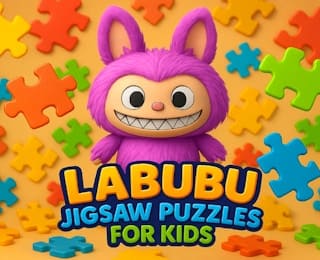
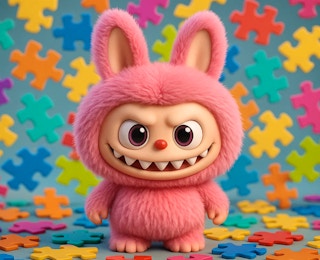
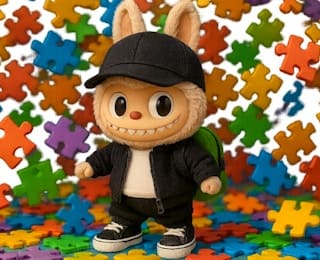
The basic flow for solving a Labubu Girls Jigsaw Puzzle scene is straightforward. Follow these steps from launch to completion:
- Open the puzzle. Load the game in your browser; a Labubu-themed scene is presented, already cut into interlocking pieces and scattered around the board.
- Scan the whole board. Before moving anything, look over the scattered pieces to spot obvious edges, corners, and bold color blocks.
- Frame the picture. Pick up the straight-edged and corner pieces first and place them to outline the border of the scene.
- Lift a piece. Click and hold (mouse) or tap and hold (touch) on a piece to pick it up.
- Drag to a candidate spot. Move the held piece toward the area where its colors and shape look right.
- Drop to place. Release to set the piece down. In many jigsaw builds a correctly positioned piece locks into place; if yours uses free placement, line the tabs and blanks up with neighboring pieces by eye.
- Build inward. Work from the frame toward the center, completing small clusters (a face, an ear, a patch of background) and then joining clusters together.
- Use a reference if shown. If the game displays a full-image preview, glance at it to confirm where an ambiguous piece belongs.
- Finish the scene. Continue until every piece is seated and the complete Labubu picture is restored; that solves the puzzle, and you can move on to the next scene.
Note: the precise buttons available (such as a preview toggle or a hint) can vary by build, so rely on the universal drag-and-drop actions above as your baseline.
Labubu Girls Jigsaw Puzzle is driven by direct manipulation of pieces. The fundamental controls are:
- Select / lift a piece: Press and hold with the mouse, or tap and hold with a finger/stylus on touch screens.
- Move a piece: While held, drag it across the board to reposition it.
- Place a piece: Release the press to drop the piece where your cursor or finger is.
- Reposition a placed piece: Lift it again with the same press-and-drag action and move it elsewhere (relevant when the build allows free placement).
These four actions cover the entire game: there is no movement of a character, no jumping, and no combat — just picking up and setting down puzzle pieces. Some jigsaw implementations add optional conveniences such as a full-image preview, a zoom, or a hint button; treat those as build-dependent extras rather than guaranteed controls, and fall back on visual matching if they are not present. For the order in which to apply these controls most effectively, see the tips and strategy guide.
The objective
The rule of the game is the rule of every jigsaw: reconstruct the original picture. Each scattered piece corresponds to exactly one location in the completed Labubu scene, determined by two things at once — the shape of its edges (the tabs that stick out and the blanks that cut in) and the slice of artwork printed on it. A puzzle is solved when all pieces occupy their correct locations so the scene appears whole, with no gaps, no overlaps, and no leftover fragments.
Completion, not points
The provided description frames the game around finishing vibrant scenes and boosting logic skills; it does not mention a points total, a timer, or a leaderboard. On that basis, success is best understood as completion: you have won a round when the image is fully assembled. If a particular build happens to track moves or time, that would be an extra layer on top of the core completion rule, not a replacement for it.
Scenes and difficulty
The wording vibrant scenes (plural) and 100+ charming pieces indicates the game offers more than one picture and that piece count is the main dial on difficulty. More pieces mean smaller slices and finer detail to match, and a busier or more uniformly colored scene is harder to read than a high-contrast one. There is no described fail state or life system — you can take as long as you need to place each piece, which is what makes the game approachable for younger players.
These are general issues that arise in browser jigsaw games like Labubu Girls Jigsaw Puzzle, with practical fixes:
- A piece will not lock into place. It is probably close but not exact. Nudge it so the tabs and blanks line up with the neighbors, and confirm the printed artwork continues smoothly across the seam.
- You cannot tell where a piece goes. Match by color family first, then by edge shape. If a full-image preview is available, compare the piece against the corresponding region of the reference.
- The board looks cluttered. Group loose pieces into small piles by dominant color or by edge type (straight edges versus interior pieces) so the active search area shrinks.
- Touch input feels imprecise on a phone. Work on a larger surface if you can, or zoom the page; place pieces deliberately and reposition them rather than expecting a single perfect drop.
- The game lags or a piece sticks. Close other tabs, refresh the page, and use an up-to-date browser; heavy graphics plus many tabs can slow an embedded player.
- You placed a piece wrongly and cannot see the seam. Lift it back out and try the neighboring slot; misaligned pieces often create a subtle bump or color break that is easier to spot once removed.
- Progress has stalled. Switch to a different region of the scene, or take a short break and return with fresh eyes — pattern recognition resets quickly.
None of these require any special feature; they rely only on the core drag-and-drop controls described on the controls section.