Setup habits for young players
Jigsaw puzzles can feel overwhelming when many pieces are on screen. These beginner-friendly habits help kids stay organized and enjoy the Labubu artwork without frustration.
- Work in a calm space: Reduce distractions so the child can focus on shapes and colors.
- Start with the easiest-looking puzzle: With 50+ puzzles available, choose an image with large, distinct features before attempting a busier picture.
- Make a piece pile: If the interface allows moving pieces freely, keep unused pieces in one area and completed sections in another.
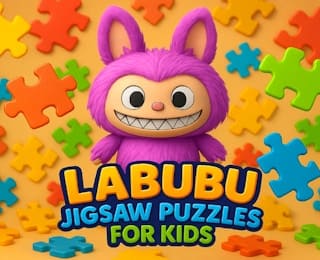
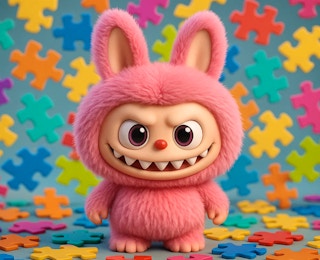
- Use the face as an anchor: Labubu’s eyes, nose, ears, and grin are memorable landmarks. Building around the face can make the rest easier.
During the puzzle
- Do edges first: Border pieces create a frame and shrink the mystery area.
- Take breaks: Short pauses help young players return with fresh eyes.
- Ask for help with fine motor tasks: Dragging small pieces can be tricky on touchscreens; an adult can demonstrate gentle clicking and releasing.
- Celebrate progress: Finishing a section is worth noticing, even before the whole puzzle is complete.
- Avoid forcing pieces: If a piece does not sit naturally, move it away and look for another gap.
These tips are especially useful for children who are new to digital puzzles. They turn a potentially chaotic screen of pieces into a sequence of small, manageable decisions.
Reading the Labubu design
Once the basics are comfortable, players can speed up solving by using visual pattern recognition. The Labubu character design offers several strong clues that can be turned into a practical strategy.
- Exploit high-contrast features: The purple body, large ears, white teeth, and dark facial outlines create natural zones. Sort pieces into those zones before placing them.
- Build sub-assemblies: Instead of placing one piece at a time, connect two or three matching pieces off to the side, then move the small cluster into the board.
- Follow the silhouette: The outer shape of the ears and head is distinctive. Edge pieces with curved boundaries can often be identified by the character outline.
- Use color gradients: Fur shading may change across the face and body. Compare light and dark purple pieces to narrow down likely regions.
Efficient placement methods
- Watch the teeth line: The wide grin is a repeating pattern of pointed shapes. Teeth pieces can be matched by the angle of the triangles and the surrounding lip line.
- Check negative space: If a gap has a unique tab pattern, scan remaining pieces for the inverse shape rather than relying only on color.
- Work from completed clusters: A small finished island, such as one eye or part of the mouth, can serve as a reference point for adjacent pieces.
- Keep the last pieces systematic: When only a few spots remain, compare the leftover pieces directly to the gaps instead of guessing randomly.
- Review the whole picture: Near the end, step back visually or scroll the attention across the image to catch subtle mismatches.
This strategy is especially useful for older kids and adults who want a more efficient solve. Younger players can still benefit by starting with the simplest version: sort by color, then build the face.