







Monster Rush - Draw Puzzle FAQ-Monster Rush - Draw Puzzle
Similar Games
What is Monster Rush - Draw Puzzle?
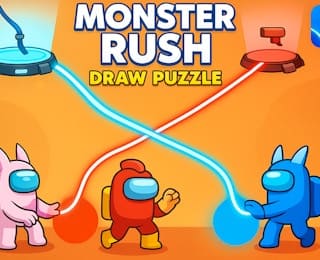
It is a drawing puzzle game where players connect colorful monster characters to matching endpoints by drawing routes. The core challenge is to satisfy every color pair through careful line placement. The game combines a doodle interface with light logic, making it easy to learn but still worth thinking about.
What is the main objective?
The objective is to link each monster to the button, pad, or target that matches its color. A puzzle is complete when all required connections have been made. The player does not need to defeat enemies or manage resources; the focus is on routing and matching.
Do I need drawing skill?
No. The game rewards clarity and planning more than artistic ability. Simple, readable lines are usually more effective than decorative doodles. If a line is neat enough to show the intended connection, it is doing its job.
Can I play with a mouse or touch screen?
The control style is direct drawing, which works naturally with a mouse, trackpad, or finger on a touchscreen. Exact device support can depend on the page hosting the game embed, but the basic interaction does not require specialized hardware.
Is the game fast-paced?
The presentation suggests a puzzle-focused pace rather than a reflex-driven one. Players are encouraged to look at the board, plan routes, and adjust lines deliberately. Speed is not the central skill; spatial reasoning is.
What should I do if I get stuck?
Stop adding new lines and review the board. Look for constrained monsters, simplify crowded routes, and adjust one connection at a time. It helps to ask which route is consuming too much space or blocking an essential lane. The Tips page covers this process in more detail.
Are colors the only important visual cue?
Color is the primary cue for matching, but position matters too. A monster near an edge or surrounded by other routes may require special planning even if its color target is obvious. Good solvers read both color and geometry.
Does the game have complex controls?
No. The main interaction is drawing a path. That simplicity is part of the appeal: the challenge comes from puzzle layout, not from memorizing buttons. New players can usually understand the controls within a few seconds.
Can routes be adjusted after drawing?
The gameplay is built around iteration. If a route causes a problem, players are expected to modify or redraw it rather than treat the first attempt as final. This makes experimentation part of the solving process.
Is Monster Rush - Draw Puzzle suitable for children?
The bright monsters, simple controls, and clear color-matching goal make it accessible for younger players. As with any online game, adult supervision may still be appropriate depending on the hosting site and the child's age.
What makes it different from other drawing games?
It is not primarily an art game. The drawing mechanic serves a puzzle objective: connecting matching colors without creating dead ends. The creative element is present, but it is guided by logic and spatial planning.
Where can I learn the rules?
Read the How to Play guide for rules, controls, and beginner habits. For a quick feature summary, see the main game page. Players who want tactical advice can visit the Tips page.
Can I play in a browser?
The game is presented through an online embed URL, indicating a browser-based format. For play-focused guidance, including controls and session flow, see the play guide.
Monster Rush - Draw Puzzle is a drawing-based puzzle game that combines simple doodle controls with route-planning strategy. The game asks players to connect colorful monster characters with matching buttons or pads by drawing lines across the screen. Its appeal comes from turning a basic draw-a-path idea into a small logic challenge: every creature needs the right connection, and the player decides how to lay out those connections.
The presentation is bright and playful, with cartoon monsters and clearly separated colors. That visual clarity is important because the puzzles rely on matching the right character to the right endpoint. A player can quickly understand the goal by scanning colors, but finding an efficient arrangement of routes still requires thought. The visible design emphasizes observation, spacing, and careful planning rather than complex menus or fast reactions.
The game sits comfortably between casual doodling and light puzzle solving. It does not ask players to master difficult controls or remember long rule sets. Instead, it invites them to look at a board, identify relationships, and draw connections in a way that satisfies every pair. That makes it approachable for younger players and satisfying for adults who enjoy compact logic challenges.
Because the title is presented as an online draw puzzle, it is well suited to short sessions. Players can try a board, adjust a route, and test a new approach without a heavy time commitment. The combination of cute monsters, bold colors, and straightforward objectives gives the game a friendly surface, while the routing decisions provide the actual challenge.
For quick access, see the play guide. For a fuller explanation of the mechanics, read the How to Play page. Players who want to improve can visit the Tips guide, and those with common questions can check the FAQ.
The visible rule system centers on matching. Each monster must be connected to the target associated with its color. A puzzle is solved when the required connections are present and correctly routed. The game does not appear to rely on combat, timing, or character abilities; the challenge comes from arranging lines so that every pair can be satisfied.
Core rule principles
| Rule element | What players should watch for | Why it matters |
|---|---|---|
| Color pairing | Each monster needs the endpoint that matches its color. | This defines the basic objective and prevents arbitrary connections. |
| Player-drawn paths | Connections are created by drawing a route across the board. | The player controls the shape and placement of every solution. |
| Board completion | All required monsters must reach their matching targets. | A partial solution is not enough; every pair must be satisfied. |
| Spatial planning | Routes share limited visual space and may affect one another. | The order and curvature of lines can determine whether the rest of the board remains solvable. |
What the rules do not emphasize
The presentation does not suggest character-specific powers, turn-based actions, or resource management. That absence is important because it keeps the focus on a single question: can the player route every color pair cleanly? The simplicity of the rule set makes the game easy to learn, while the spatial arrangement of the board provides the challenge.
For step-by-step execution, see the How to Play guide. For advice on avoiding rule-related errors, read the Tips page.
Monster Rush - Draw Puzzle uses direct drawing controls. On a touchscreen, players can drag a finger to create a line. On a desktop browser, the same action can be performed with a mouse or pointer. The control scheme is intentionally simple: press or touch, drag along the intended route, then release to finish the stroke.
What the controls emphasize
- Direct interaction: the player draws the connection rather than selecting it from a menu.
- Deliberate movement: smooth, controlled strokes are more useful than fast flicks.
- Visual feedback: because routes are visible immediately, players can judge whether a line is likely to interfere with other connections.
- Low memorization load: there are no suggested complex key bindings or multi-step commands.
Because the game is presented as a drawing puzzle, deliberate placement is usually more important than rapid movement. Players can focus on clean lines, correct endpoints, and readable routes. If a connection needs changing, the natural response is to adjust the route rather than react under pressure.
The simple control model also makes the game accessible. New players can understand the interaction within seconds, while experienced puzzle players can use the same controls to experiment with different routing ideas. For a broader explanation of the loop, see the play guide.