







Play Monster Rush - Draw Puzzle Online-Monster Rush - Draw Puzzle
Similar Games
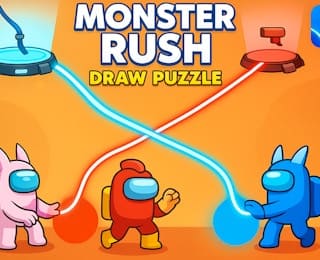
Monster Rush - Draw Puzzle uses direct drawing controls. On a touchscreen, players can drag a finger to create a line. On a desktop browser, the same action can be performed with a mouse or pointer. The control scheme is intentionally simple: press or touch, drag along the intended route, then release to finish the stroke.
What the controls emphasize
- Direct interaction: the player draws the connection rather than selecting it from a menu.
- Deliberate movement: smooth, controlled strokes are more useful than fast flicks.
- Visual feedback: because routes are visible immediately, players can judge whether a line is likely to interfere with other connections.
- Low memorization load: there are no suggested complex key bindings or multi-step commands.
Because the game is presented as a drawing puzzle, deliberate placement is usually more important than rapid movement. Players can focus on clean lines, correct endpoints, and readable routes. If a connection needs changing, the natural response is to adjust the route rather than react under pressure.
The simple control model also makes the game accessible. New players can understand the interaction within seconds, while experienced puzzle players can use the same controls to experiment with different routing ideas. For a broader explanation of the loop, see the play guide.
A typical session begins with a puzzle board containing several monsters and several colored endpoints. The player's first job is not to draw immediately, but to read the board. Identify each character, locate its matching target, and imagine a route that will not interfere with the other connections. This short planning phase is often the difference between a smooth solve and a frustrated redraw.
Recommended play flow
- Survey the board: count the monsters and endpoints before making a move. Note which colors are present and where they are positioned.
- Identify constrained pairs: look for monsters near edges, corners, or crowded areas. These connections often need attention early because they have fewer alternative routes.
- Start with the clearest pair: choose a connection with an obvious open path. Securing one clean route can make the remaining board easier to read.
- Draw deliberately: create a smooth line toward the matching target. Avoid excessive loops unless they serve a purpose, such as reserving space for another connection.
- Re-evaluate after each route: check whether the new line makes remaining connections easier or harder. This feedback loop is central to the gameplay.
- Adjust when needed: if a later pair cannot connect, redraw the earlier route with a different curve or position. Small adjustments are usually more efficient than starting over.
Example planning pattern
Suppose a board contains a red monster, a blue monster, and a pink monster. The player should first locate the red, blue, and pink targets. If the red route has a clear diagonal path but the blue route must pass through a narrow area, it may be wise to plan the blue connection before finalizing the red one. The exact solution depends on the board, but the principle is the same: use the easiest-looking route only after confirming it will not trap a harder route.
The gameplay loop is compact and repetitive in a positive way: observe, draw, verify, refine. That makes it suitable for short play sessions while still offering enough planning depth to keep puzzle fans engaged. Players who want to improve recognition and route choice can review the tips page.
Monster Rush - Draw Puzzle is defined by a small set of clear features that work together. The game is not trying to overwhelm players with systems; instead, it focuses on a readable puzzle loop with a creative drawing layer.
Main features
- Drawing puzzle core: players create paths by hand instead of selecting prebuilt routes. This gives each solution a personal feel and makes the act of solving part of the fun.
- Color matching: monsters and targets are distinguished by clear colors, making the objective easy to read. Color becomes the primary signal for which connections are allowed or required.
- Strategy with a doodle twist: the game feels simple, but route order and spacing can turn each puzzle into a small planning challenge. The doodle interface hides a logic problem underneath.
- Accessible presentation: bright characters and minimal interface lower the barrier for new players. The game does not require prior puzzle experience to understand what is on screen.
- Browser-friendly play: the title is presented as an embeddable online game, suitable for quick sessions. That format supports casual play without demanding a heavy setup.
- Low control complexity: the main interaction is dragging a line. Because controls are simple, players can focus attention on the board rather than on input mechanics.
These features make the game approachable for casual players while still giving puzzle fans something to think about. The result is a title that can be picked up quickly but rewarded with careful play. Readers who want a fuller breakdown can compare the rules and strategy tips.
Many difficulties in Monster Rush - Draw Puzzle come from habits that feel efficient but actually create congestion. Recognizing these mistakes helps players diagnose stuck boards faster.
Mistakes new players make
- Drawing too quickly: starting a line before checking all endpoints often creates routes that block later pairs. A few seconds of scanning can prevent a full redraw.
- Ignoring constrained monsters: a character with little open space may need priority, even if another pair looks easier. Flexible routes can often be adjusted later; constrained routes cannot.
- Overcomplicating lines: excessive loops and sharp bends can waste board space. Unless a curve reserves room for another connection, simplicity is usually stronger.
- Forgetting to verify all colors: players may solve most pairs and miss one unmatched monster. A final color-by-color check avoids incomplete solutions.
- Adjusting randomly: when stuck, changing a single problematic route is usually more effective than clearing everything. Random resets make it harder to learn which decision caused the issue.
- Cluttering the center: routing every line through the middle can create a visual traffic jam. Edge paths and outer lanes often preserve flexibility.
- Treating the first draft as final: puzzle boards reward iteration. A route that looks good initially may need a small bend to accommodate another pair.
Avoiding these mistakes turns the game from trial-and-error doodling into a more satisfying logic exercise. For corrective habits, read the How to Play guide and the strategy section.