







Monster Rush - Draw Puzzle Tips and Strategy-Monster Rush - Draw Puzzle
Similar Games

Beginners often treat the game as a pure drawing task, but the real skill is planning before the pen or finger touches the board. The following habits help new players move from random doodling to intentional solving.
Core beginner habits
- Look before you draw: scan all monsters and endpoints first. Connecting the first obvious pair can block a less obvious route.
- Use color as your anchor: match character to endpoint visually before planning the line. Color is the main rule signal, so confirming it reduces mistakes.
- Keep lines simple: unnecessary curves can consume space and make later connections harder. A clean route is usually easier to adjust than a tangled one.
- Solve obvious routes first: if one monster has a direct path and does not interfere with others, secure it early. This can clarify the remaining board.
- Prioritize constrained monsters: characters near edges or in crowded areas may have fewer options. Planning them before flexible central pairs can prevent dead ends.
- Expect to adjust: the first attempt is a draft. Changing routes is part of the puzzle, not a sign of failure.
- Work from the outside inward: edge connections can define safe space for central routes. This habit is especially useful when multiple lines compete for the middle of the board.
- Verify before moving on: after each connection, check that the remaining pairs still have plausible paths. Early verification saves time later.
These tips are intentionally simple. The goal is to build a repeatable routine: observe, match, plan, draw, verify. Once that routine becomes natural, players can move on to the more advanced route-economy ideas on the Tips page.
Strategy in Monster Rush - Draw Puzzle is about route economy. Because the board has limited visual space, the order in which connections are made can matter. A good solver thinks ahead: if a straight route for one monster would cut off another monster's only path, it may be better to curve the first route around the edge. The challenge is not to draw the longest or fanciest line, but to create a set of routes that coexist cleanly.
Planning tactics
- Identify constrained pairs first: monsters near corners or with few open lanes should be planned before flexible central pairs. Constrained routes have less freedom, so they benefit from early attention.
- Leave breathing room: avoid packing all lines through the same corridor. If several routes compete for one narrow area, the puzzle may become needlessly difficult.
- Use negative space: empty areas are as important as the drawn lines. Preserving open lanes can make later connections possible.
- Test the hardest connection early: if one pair seems difficult, sketch its route mentally before committing others. Confirming the hard path first can prevent a full redraw later.
- Adjust with purpose: when stuck, change one route at a time instead of clearing the whole board. Isolated adjustments help players learn which line caused the problem.
- Think in layers: place foundational routes first, then fill in easier connections. A layered approach reduces visual clutter.
- Prefer reversible choices: when two plans seem equally good, choose the one that is easier to modify if a later pair fails.
Strategic mindset
The goal is not speed. The goal is a clean configuration where every color pair is satisfied without creating a dead end for another connection. Strong players often spend more time looking than drawing. They treat each line as a commitment that affects the rest of the board, and they are willing to refine a route if it improves overall solvability.
Beginners can build toward this mindset with the How to Play guide, while players seeking quick troubleshooting can review common mistakes.
Many difficulties in Monster Rush - Draw Puzzle come from habits that feel efficient but actually create congestion. Recognizing these mistakes helps players diagnose stuck boards faster.
Mistakes new players make
- Drawing too quickly: starting a line before checking all endpoints often creates routes that block later pairs. A few seconds of scanning can prevent a full redraw.
- Ignoring constrained monsters: a character with little open space may need priority, even if another pair looks easier. Flexible routes can often be adjusted later; constrained routes cannot.
- Overcomplicating lines: excessive loops and sharp bends can waste board space. Unless a curve reserves room for another connection, simplicity is usually stronger.
- Forgetting to verify all colors: players may solve most pairs and miss one unmatched monster. A final color-by-color check avoids incomplete solutions.
- Adjusting randomly: when stuck, changing a single problematic route is usually more effective than clearing everything. Random resets make it harder to learn which decision caused the issue.
- Cluttering the center: routing every line through the middle can create a visual traffic jam. Edge paths and outer lanes often preserve flexibility.
- Treating the first draft as final: puzzle boards reward iteration. A route that looks good initially may need a small bend to accommodate another pair.
Avoiding these mistakes turns the game from trial-and-error doodling into a more satisfying logic exercise. For corrective habits, read the How to Play guide and the strategy section.
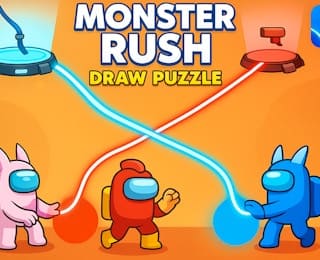
The visible rule system centers on matching. Each monster must be connected to the target associated with its color. A puzzle is solved when the required connections are present and correctly routed. The game does not appear to rely on combat, timing, or character abilities; the challenge comes from arranging lines so that every pair can be satisfied.
Core rule principles
| Rule element | What players should watch for | Why it matters |
|---|---|---|
| Color pairing | Each monster needs the endpoint that matches its color. | This defines the basic objective and prevents arbitrary connections. |
| Player-drawn paths | Connections are created by drawing a route across the board. | The player controls the shape and placement of every solution. |
| Board completion | All required monsters must reach their matching targets. | A partial solution is not enough; every pair must be satisfied. |
| Spatial planning | Routes share limited visual space and may affect one another. | The order and curvature of lines can determine whether the rest of the board remains solvable. |
What the rules do not emphasize
The presentation does not suggest character-specific powers, turn-based actions, or resource management. That absence is important because it keeps the focus on a single question: can the player route every color pair cleanly? The simplicity of the rule set makes the game easy to learn, while the spatial arrangement of the board provides the challenge.
For step-by-step execution, see the How to Play guide. For advice on avoiding rule-related errors, read the Tips page.