





Pixeler Drawing Game Tips and Strategy-Pixeler Drawing Game
Similar Games





Start With Simple Shapes
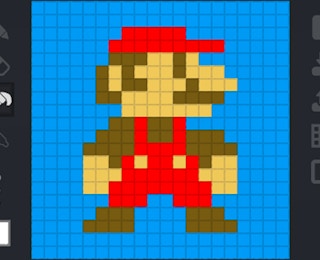
Beginners often try to draw complex characters immediately. A better first step is to practice circles, rectangles, hearts, stars, mushrooms, and simple faces. These shapes teach how diagonal lines behave on a grid and how few pixels are needed to suggest a form.
Use Fewer Colors Than You Think
Although the game advertises 1000+ color combinations, a strong beginner drawing usually uses a small set of colors. Try limiting yourself to four or five shades: background, base, shadow, highlight, and accent. This makes the image cleaner and helps you learn how color relationships work.
Check Contrast Early
Pixel art can look muddy when adjacent colors are too similar. After placing a shape, ask whether it separates from the background. If not, adjust either the subject color or the surrounding color. Good contrast is more important than intricate detail.
Work From Background to Foreground
Establish the largest areas first. Backgrounds, clothing, hair, and major body masses should be blocked before eyes, buttons, or tiny highlights. This order prevents details from being misplaced when the overall shape changes.
Keep an Eye on Symmetry
Many pixel subjects, especially faces and icons, look better when balanced. Count cells mentally or compare left and right sides. Small asymmetries can be charming, but accidental unevenness often makes a drawing look unfinished.
Correct Mistakes Without Panic
Because the drawing is made of individual cells, mistakes are local. If one pixel is wrong, repaint that cell instead of restarting the whole piece. This forgiving process encourages experimentation.
Practice One Skill at a Time
- Shape practice: draw the same object using only two colors.
- Shadow practice: add one shadow tone to a flat shape.
- Outline practice: compare no outline, dark outline, and colored outline.
- Palette practice: recreate the same drawing with warm and cool color sets.
The most important beginner habit is finishing small pieces. A completed simple drawing teaches more than an abandoned ambitious one.
Plan the Focal Point
A strong pixel drawing guides the viewer's eye to one main area. Decide before you paint where the focal point will be: a face, a gem, a logo, a light source, or a contrasting color patch. Use your brightest highlight, darkest shadow, or most saturated accent near that point.
Use Value Before Hue
When an image looks weak, the problem is often value rather than color. Value is how light or dark a color appears. A useful strategy is to imagine the drawing in grayscale: if the shapes still read clearly, the value structure is solid. Adjust light and dark areas before adding more hues.
Create Depth With Limited Gradients
The large palette makes gradients possible, but pixel art often looks cleaner with controlled steps. Instead of blending every cell smoothly, choose three to five values for a major surface: base, shadow, deep shadow, highlight, and specular accent. Place them consistently according to the light source.
Consider Dithering Patterns
Dithering uses alternating pixels to suggest a transition between two colors. It can be especially effective for skies, skin shading, and soft shadows. Start with a sparse checker pattern, then densify the transition where one color should dominate. Use dithering intentionally; overuse can make a small grid look noisy.
Design Outlines Strategically
Outlines can unify a pixel drawing, but a pure black outline is not always best. Consider using a dark version of the object's own color for inner edges and a darker neutral for outer boundaries. This keeps characters vibrant while preserving separation from the background.
Balance Detail Density
Not every cell needs information. Leave resting areas where the eye can recover. A face may need dense detail around the eyes and mouth, but simpler planes on the cheeks and forehead. Balanced detail density makes small drawings feel professional.
Build a Reusable Color Logic
For characters, define a rule set: skin base, skin shadow, skin highlight, clothing primary, clothing secondary, metal accent, and eye color. Reusing a logical palette across multiple drawings helps develop a recognizable style and speeds up future sessions.
Evaluate at Actual Size
Pixel art is often viewed small. A strategy that looks good while zoomed into individual cells may fail when seen as a whole. Periodically assess the overall silhouette and color masses. If the drawing only works when inspected cell by cell, simplify it.
Advanced Exercise: Three-Pass Rendering
- Pass one: block the shape with one flat color.
- Pass two: add only shadow and highlight, no new hues.
- Pass three: add accent details and edge refinement.
This method trains discipline and prevents premature detail. It also makes the large color palette more manageable, because each pass has a specific job.