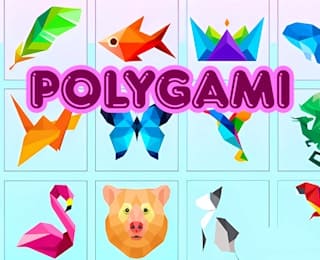
Beginners benefit from treating Polygami Jigsaw Puzzles as a visual sorting exercise before it becomes a speed challenge. The geometric animal style is rewarding, but bright colors and many triangular facets can overwhelm new players if they start placing pieces randomly.
- Look before you place. Spend the first moments studying the whole animal image. Identify the head, body, limbs, wings, fins, or decorative elements.
- Sort mentally by color family. Group pieces into warm tones, cool tones, neutrals, and accent colors. This reduces clutter in your mind.
- Start with the most obvious shape. A bright beak, a dark eye, a tall fin, or a pointed ear is usually easier to locate than a mid-body triangle.
- Work in one region at a time. Completing a small section builds momentum and creates reference points for nearby pieces.
- Do not force placements. If a polygon does not align cleanly with neighboring edges, reconsider its orientation or region.
- Use symmetry when present. Many animal designs have mirrored left and right sides. Solving one side can guide the other.
A simple warm-up routine
- Pick one target image and name five anchor areas aloud or in your head.
- Find the three most unique pieces, such as a bright accent, a sharp point, or a dark outline fragment.
- Place those anchors before touching common mid-tone polygons.
- Complete one small region, then pause and reassess the remaining gaps.
These habits help new players avoid the most common source of frustration: treating every piece as equally urgent.
Once the basics feel comfortable, tactical play is about improving efficiency and accuracy. Polygami polygonal art rewards players who can read edges, shadows, and negative space quickly.
High-value tactics
- Anchor with unique angles. Rare acute triangles, long slender shapes, or unusual color blocks are easier to place early because they have fewer possible homes.
- Follow edge continuity. Match the direction of slanted borders. A piece that continues a wing edge or tail line is often correct even if the color is similar elsewhere.
- Build from contrast boundaries. Places where two colors meet are excellent clues. The boundary line tells you which facets should be adjacent.
- Use empty-space geometry. A gap with three sides defined often reveals the missing polygon orientation. Visualize the missing shape before selecting a piece.
- Complete frames around features. If a face or ornament is partially built, finish its border first. That locks the feature in place and prevents drift.
- Reserve ambiguous pieces. Generic triangles with common colors are safer to place later, when surrounding context narrows their options.
Pace control
Fast solving is useful only if it does not create misplacements. A steady rhythm - scan, select, test, confirm - usually outperforms rapid random attempts, especially in dense geometric animal designs.
Error recovery
If a section looks wrong, do not rebuild everything at once. Remove only the most suspect pieces, recheck the boundary colors, and replace them one by one. Small corrections preserve momentum and reduce frustration.
Most difficulties in Polygami Jigsaw Puzzles come from visual overload rather than lack of ability. Recognizing common mistakes can shorten the learning curve significantly.
| Mistake |
Why it slows you down |
Better habit |
| Starting with random interior pieces |
The puzzle loses structure and becomes harder to reason about |
Place outline or feature anchors first |
| Ignoring the overall silhouette |
A piece may match locally but break the animal outer shape |
Check the full form after each cluster |
| Overlooking orientation |
Polygonal pieces often need mental rotation, and a wrong point direction creates subtle errors |
Compare slanted edges before committing |
| Chasing one color everywhere |
Similar hues can appear in multiple body regions |
Use neighboring edges and shadows, not color alone |
| Neglecting negative space |
Empty gaps are information, and ignoring them removes easy clues |
Read each gap as a shape prompt |
| Rushing near completion |
The final pieces are often ambiguous because remaining spaces are small |
Slow down and verify each placement |
Avoiding these mistakes makes the puzzle feel calmer and helps players appreciate the geometric animal artwork rather than fighting the interface.