






How to Play Rotate Puzzle: Jigsaw Twist-Rotate Puzzle: Jigsaw Twist
Similar Games

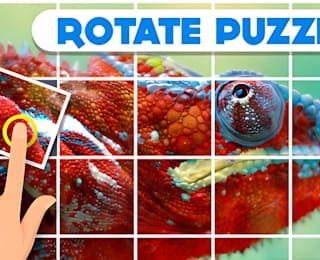
How to play Rotate Puzzle: Jigsaw Twist is centered on a simple question: does this tile belong in this orientation? The puzzle presents an image divided into a grid, and the player rotates individual pieces until the full picture is restored. The following walkthrough explains the basic loop from loading a challenge to completing the grid.
1. Open a grid challenge
Start by loading the game through the online platform described in the game information. Once a puzzle appears, resist the urge to click immediately. The first task is orientation: understand what image you are reconstructing and how large the grid is.
2. Study the whole picture
Scan the board for recognizable elements. Photographic puzzles often contain faces, animal features, sky gradients, foliage, patterns, or strong color blocks. These details act as navigation points. If the image is abstract, look for lines, curves, repeated shapes, and contrast boundaries.
3. Find already-correct pieces
Some tiles may already be aligned. Identify pieces whose edges match adjacent colors or whose internal details appear continuous. Mark them mentally as anchors. Anchors reduce uncertainty because every neighboring unknown piece can be compared to something reliable.
4. Rotate one piece at a time
Select a tile near an anchor and rotate it. After each rotation, check whether the piece connects better with its neighbors. The key is incremental testing: one turn, one comparison, one decision. Avoid rotating many pieces in succession without evaluating the result.
5. Match edges before centers
A piece can look convincing in the middle but wrong at the border. Always compare the four sides of a tile with the surrounding tiles. Straight lines, color transitions, and texture flow should continue smoothly across piece boundaries.
6. Expand the solved region
Once a small cluster is correct, use it as a new base. Move outward to adjacent tiles, solving one neighborhood at a time. This method is especially useful in larger grids because it prevents the whole board from feeling chaotic.
7. Save ambiguous tiles for later
Tiles with flat color, blur, or repetitive texture may be hard to orient early. Leave them until the surrounding area is mostly complete. With more solved neighbors, the correct rotation becomes easier to infer.
8. Perform a final check
When the image looks finished, review the grid systematically. Look for broken lines, mismatched shadows, odd repeats, or pieces that seem flipped relative to the overall composition. Correct any remaining anomalies before moving to the next challenge.
What to do when the image is unfamiliar
Not every grid challenge will show an instantly recognizable object. In those cases, switch from object recognition to relationship recognition. Look for gradients that should flow in one direction, lines that should remain straight, and color blocks that should not be interrupted. The solution is still based on continuity, even when the subject is abstract.
How to know if you are making progress
Progress in a rotation puzzle is not always dramatic. A solved region may be small, and a single correct piece can improve several seams at once. If two or more edges match after a rotation, you are likely moving in the right direction. If a rotation improves one edge but damages two others, revert your approach and test a different piece.
A simple practice routine
For the first few challenges, practice a consistent routine: scan, anchor, rotate, verify, expand. Repeating the same sequence helps build muscle memory and reduces the temptation to click randomly. Once the routine feels natural, you can adapt it to different image styles and grid sizes.
This basic loop applies across the 25+ grid challenges mentioned in the game description. For a deeper explanation of what is confirmed and what is not specified, read the game rules section below. For improvement tactics, visit the tips page.
The rules of Rotate Puzzle: Jigsaw Twist are straightforward, but it is useful to separate confirmed information from assumptions. The game is described as a rotate-based jigsaw puzzle with free online play and 25+ grid challenges. The core rule is that players must correct the orientation of grid pieces so the displayed image becomes coherent.
Confirmed rule structure
- The puzzle is shown as a grid of image pieces.
- Pieces can be rotated through the primary interaction.
- The objective is to restore the full image by aligning piece orientations.
- The game includes 25+ grid challenges according to the description.
- Play is available online through LightPlayHub with unlimited access as stated.
What a solved state means
A solved puzzle is reached when the image reads continuously across the entire grid. That means colors, lines, textures, and recognizable objects should not be interrupted by incorrect tile orientation. In practical terms, every piece should match its neighbors along all shared edges.
Interaction rules
The available information indicates rotation is the central action. Players interact with individual tiles, and each interaction changes the orientation of that tile. The exact number of orientation states is not specified in the short description, so players should learn the rotation step by testing a piece in the live game.
How the challenge count affects play
The mention of 25+ grid challenges suggests that players will encounter multiple boards with different images and possibly different levels of visual complexity. Even without confirmed difficulty labels, the practical rule is the same for each board: restore continuity across the grid. Treat each challenge as an independent puzzle and begin with a fresh scan rather than relying on memory from the previous image.
Features not confirmed by the description
| Topic | Status in available information |
|---|---|
| Scoring system | Not specified |
| Timer | Not specified |
| Move limit | Not specified |
| Hints | Not specified |
| Undo button | Not specified |
| Multiplayer | Not specified |
This distinction matters because some puzzle games add pressure through timers or scores, while others are purely meditative. Based on the provided description, Rotate Puzzle: Jigsaw Twist should be approached as a visual reconstruction challenge whose confirmed structure is grid-based rotation across multiple puzzles.
For step-by-step play, see the how to play section above. For control details, visit the play guide.
Beginners often improve quickly in Rotate Puzzle: Jigsaw Twist by replacing random clicking with a small set of observation habits. The game does not require advanced knowledge, but it does reward patience and visual discipline. These tips are designed for the first several grid challenges.
Start with the most obvious image feature
If the puzzle contains an eye, a bright flower, a dark outline, or a strong color patch, begin there. Obvious features are easier to recognize when rotated correctly, so they provide a reliable starting point.
Do not rotate pieces without a purpose
Every click should answer a question: does this orientation make the edge match better? Random rotation can create false progress and make it harder to remember which pieces have been tested.
Learn the rotation direction early
Before solving a full grid, test one piece and notice how it turns. Whether the game uses one-direction cycling or another interaction pattern, understanding the step size prevents accidental over-rotation. This is especially important on touch screens where a quick series of taps can move a piece past its correct orientation.
Use neighboring pieces as evidence
A single tile rarely reveals its correct orientation in isolation. Compare it with the tiles above, below, left, and right. If two pieces share a line or color transition, that connection is stronger evidence than the texture inside one piece.
Work in small zones
Instead of jumping across the board, solve a 2x2 or 3x3 area. Small zones are easier to manage and give a sense of completion. Once a zone is stable, expand outward.
Accept uncertainty temporarily
Some pieces will remain ambiguous until more of the image is solved. Do not stall on one difficult tile. Move to a clearer area and return later with more context.
Check your work before declaring victory
A puzzle can look almost correct while containing one rotated piece that subtly breaks a line or shadow. Scan the full grid before moving to the next challenge.
These beginner habits build the foundation for more advanced methods. For deeper tactics, see the strategy guide, and for control specifics, read the play guide.