







Rotate Puzzle: Jigsaw Twist Tips and Strategy-Rotate Puzzle: Jigsaw Twist
Similar Games

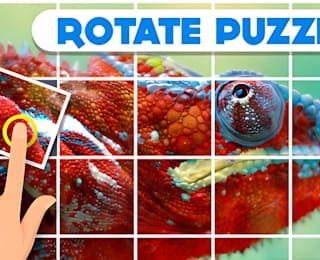
The strategy layer in Rotate Puzzle: Jigsaw Twist is about reducing uncertainty faster. Since the confirmed mechanic is rotating grid pieces to restore an image, the most effective players treat each puzzle as a network of edge relationships rather than a collection of independent tiles. The following approaches help turn basic solving into a more efficient habit.
Build a reference map before rotating
Scan the entire grid and identify three kinds of landmarks: high-contrast objects, continuous lines, and color boundaries. High-contrast objects are easy to recognize, continuous lines reveal orientation quickly, and color boundaries show whether a tile is flipped relative to its neighbor. Creating this mental map takes only a few seconds but prevents aimless clicking.
Solve boundaries first when the image has clear edges
If the puzzle contains a horizon, a face outline, a geometric shape, or a strong border, start with pieces that lie along that boundary. Boundary pieces often have fewer plausible orientations because one side must continue a visible line or abrupt color change. Once the boundary is established, interior pieces become easier to place.
Use the corner and edge heuristic carefully
In many grid puzzles, corner and edge pieces are constrained by the outer frame. If the game presents a complete rectangular image, pieces along the outside may have visual cues such as background fade, border lines, or cropped objects. Use these cues, but do not assume every outer piece is automatically correct; rotation can still make an edge piece appear plausible while misaligning its inner edge.
Group pieces by confidence level
Mentally classify tiles into three groups: certain, probable, and ambiguous. Solve certain pieces first, use them to test probable pieces, and postpone ambiguous pieces until the surrounding context is rich. This confidence grouping is one of the most transferable skills in visual rotation puzzles.
Think in seams, not squares
A common mistake is evaluating a tile by its center texture. The true solution lives at the seams. After each rotation, check all shared edges. If a seam is interrupted, the piece is probably wrong even if its center looks attractive.
Exploit repetition and symmetry
Some images contain repeated patterns, mirrored shapes, or regular textures. These can accelerate solving because the correct orientation often restores rhythm. However, repetition can also create traps: a piece may match one neighbor but break the larger pattern. Always verify against multiple sides.
Perform a structured final sweep
When the image appears solved, do not stop immediately. Sweep row by row and column by column. Look for subtle discontinuities: a line that jumps, a shadow that reverses, a texture that repeats unnaturally, or a color gradient that changes direction. A structured audit catches the last errors that casual inspection misses.
These strategic ideas are expanded in the advanced tips and common mistakes sections below. For basic instructions, return to the how to play guide.
Advanced play in Rotate Puzzle: Jigsaw Twist is less about discovering new mechanics and more about refining perception. Once the basic loop is familiar, the challenge becomes speed, accuracy, and consistency across the 25+ grid challenges. The following tips are intended for players who already understand the controls and want to solve with fewer wasted rotations.
Develop a rotation hypothesis
Before clicking a piece, predict where it should go. If a line should continue to the right, imagine the piece in that orientation first. Then rotate and compare. This hypothesis-testing approach reduces blind experimentation and strengthens visual memory.
Minimize disturbance to solved regions
As the puzzle progresses, solved areas become reference anchors. Avoid clicking near the boundary of a solved region unless necessary. If you must test a piece next to solved tiles, do so deliberately and recheck the seam immediately afterward.
Use elimination on ambiguous tiles
When a tile has flat color or soft detail, consider which orientations are impossible. If one edge clearly does not match a neighbor, eliminate that orientation. Even without knowing the correct answer, elimination narrows the possibilities and makes later testing faster.
Create mental checkpoints
For larger grids, divide the board into quadrants or horizontal bands. Complete one checkpoint before moving to the next. Checkpoints help maintain orientation and make it easier to identify where an error was introduced if the final image looks wrong.
Train edge-reading speed
Efficient solvers quickly assess whether two adjacent edges match. Practice by scanning pairs of tiles and asking a simple question: do the colors, lines, and textures continue smoothly? Over time, this becomes instinctive and reduces the need for repeated rotations.
Recover from errors systematically
If the completed image seems off, do not randomly rotate pieces. Find the most obvious discontinuity, then trace outward to the nearest suspect tiles. Errors often cluster around ambiguous pieces that were solved early with insufficient context.
Adapt to image type
Photographic puzzles reward attention to faces, objects, lighting, and depth. Abstract puzzles reward attention to geometry, repetition, and contrast. Adjust your anchor selection to the image type instead of using the same routine for every grid.
For a broader strategic foundation, read the strategy guide above. To avoid common inefficiencies, see the common mistakes section below.
Most difficulties in Rotate Puzzle: Jigsaw Twist come from habits that feel productive but actually slow the solve. Recognizing these mistakes helps players stay systematic across the game’s grid challenges.
Rotating pieces randomly
Clicking without a hypothesis turns the puzzle into trial and error. Random rotation can disrupt already-correct areas and makes it harder to remember which orientations have been tested. Always rotate with a reason, even if that reason is simply to test one suspected edge.
Judging pieces by their centers
A tile may look correct in the middle while its borders do not match the surrounding image. Center-focused evaluation is one of the most common beginner errors. Check shared edges first, then use the center as secondary confirmation.
Ignoring the outer frame
If the puzzle image has borders, horizons, cropped objects, or background gradients, outer pieces often contain strong orientation clues. Overlooking these clues forces players to solve edge pieces with less information than necessary.
Stalling on ambiguous tiles
Flat colors, blur, and repetitive textures can be genuinely difficult to orient early. Spending too long on one ambiguous piece wastes momentum. Move to a clearer region and return when neighboring context is stronger.
Assuming a near-match is correct
Puzzles can contain deceptive similarities. A piece may align with one neighbor but conflict with another. Verify each candidate orientation against all adjacent sides before treating it as solved.
Skipping the final audit
Many players stop when the image looks mostly right. A single misrotated tile can break a line, reverse a shadow, or create an unnatural repeat. A row-by-row and column-by-column check catches these late-stage errors.
Not adapting strategy between challenges
With 25+ grid challenges, image types may vary. Reusing the same anchor point or solving order without checking the new picture can reduce efficiency. Start each challenge with a fresh scan.
For constructive alternatives to these mistakes, read the strategy guide and advanced tips on this page.