






How to Play Trezelines-Trezelines: Drawing Puzzle Challenge
Similar Games
How to Play Trezelines: Step-by-Step
Trezelines: Drawing Puzzle Challenge is played by observing a physics scene and drawing lines that help solve the puzzle. The following routine gives new players a clear method for approaching each screen.
1. Inspect the Full Puzzle
Before drawing anything, scan the entire play area. Look for suspended objects, loose planks, coins, cup-like containers, water-like boundaries, and any indicator such as the lives counter. Understanding what can move is more important than immediately choosing where to draw.
2. Identify the Likely Goal
Ask what the scene seems to want. An object may need to be redirected, stabilized, lifted, lowered, caught, or guided into a container. Even when the exact objective is not written on screen, the arrangement of hazards and targets usually suggests the intended outcome.
3. Plan the Line Before Drawing
Because the game highlights 13 gravity-defying lines, treat each stroke as a limited resource. Visualize the angle, length, and position of the line. A well-planned line can replace several improvised strokes.
4. Draw One Meaningful Stroke
Start with a single line that addresses the most unstable or important object. Short lines can act as bumpers, angled lines can work as ramps, and longer lines can serve as bridges or shelves. Testing one change at a time makes it easier to learn cause and effect.
5. Watch the Physics Response
After drawing, observe how objects react. Swinging weights may change arc, planks may tilt, coins may slide, and containers may receive or miss an object. The response is the feedback that tells you whether the plan is working.
6. Refine Instead of Panicking
If the attempt fails, avoid redrawing everything at once. Identify the first wrong assumption: Was the line too steep, too short, too late, or placed in the wrong zone? Make one targeted adjustment on the next attempt.
7. Progress Through the Puzzle Set
With 50+ physics puzzles, the game is designed as a sequence of challenges. Early puzzles teach basic interactions, while later puzzles are likely to combine more objects, tighter spacing, and less forgiving timing.
Understanding Failure Feedback
Failure is information. If an object overshoots, the line may be too steep or placed too early. If it stalls, the line may be too flat or too short. If a secondary object moves unexpectedly, the solution may need a barrier or support elsewhere. Reading these signals is part of learning the game.
Drawing Discipline
Discipline means resisting the urge to fill empty space. The best line is often the smallest one that changes the critical path. Before each stroke, confirm that it has a clear job. If it does not, leave the space open for a later, more precise correction.
Screen Reading Tips
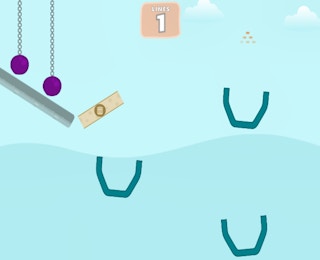
The sample interface uses a light blue background, hanging purple balls, gray and wooden planks, a coin, teal cup shapes, and a lives display. These visual cues help separate stable scenery from movable puzzle pieces. Objects attached by chains are likely to swing, while loose planks may rotate or slide when contacted.
A Beginner Routine
- Pause for five seconds and trace the likely path in your mind.
- Choose the object that threatens the solution the most.
- Draw one line that changes that object's path.
- Watch the result without rushing the next stroke.
- Repeat with a smaller correction if needed.
This routine reduces impulsive drawing and helps players conserve both lines and lives.
Key Mechanics Behind the Puzzle Challenge
Trezelines combines drawing input with simulated physics. The mechanics are simple to describe but layered in practice because each line can affect multiple objects.
Drawn Lines as Physical Surfaces
The core mechanic is the transformation of a player stroke into a functional surface. Depending on placement, a line can block movement, redirect an object, support a plank, create a ramp, or form a boundary near a target area. This makes drawing an act of level editing inside the puzzle itself.
Gravity and Falling Motion
The phrase gravity-defying lines points to a mechanic where players must counteract or guide downward movement. Objects that fall, drop, or tilt need to be intercepted at the right height and angle. A line placed too high may miss, while a line placed too low may arrive after the object has already gained problematic momentum.
Swinging and Momentum
Suspended balls visible in the sample scene suggest pendulum-like motion. Swinging objects do not stop at the point of contact; they continue along an arc unless redirected by a surface. Mechanics involving momentum reward players who anticipate future positions rather than reacting to current positions.
Plank Interaction
Wooden and gray plank elements indicate rotational and leverage behavior. A plank can act as a bridge, seesaw, blocker, or transfer surface. Where a line touches a plank may determine whether it stabilizes the plank or causes it to tip in an unwanted direction.
Containers and Target Areas
Teal U-shaped forms resemble cups or containers. These elements likely function as targets, catch zones, or obstacles. Guiding an object into the center of a container is usually safer than striking the edge, where bouncing or slipping can occur.
Water-Like Hazards or Channels
The wavy blue area suggests a liquid boundary. In physics puzzles, water-like regions can be hazards, buoyant surfaces, or visual separators. Until a puzzle demonstrates otherwise, treat them as areas that may change how objects behave or as boundaries to avoid.
Lives as a Feedback Mechanic
The lives counter adds consequence to experimentation. It turns the game from a pure sandbox into a challenge where careless attempts have a cost. This mechanic encourages players to observe first, draw second, and refine third.
Line Economy
The 13-line theme introduces efficiency as a mechanic. Even if a puzzle can be solved with many strokes, the design pressure is to solve it with purposeful ones. Line economy makes the drawing phase strategic rather than spontaneous.