






Trezelines Strategy Guide-Trezelines: Drawing Puzzle Challenge
Similar Games
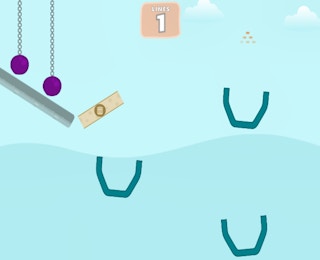
Strategic Approach to Solving Puzzles
As puzzles become more complex, success depends less on individual strokes and more on planning the whole solution. A strong strategy treats each line as a commitment that changes the physics system.
Work Backward from the Desired Outcome
Start by imagining the final safe state. Where should the key object end up? What surface must it touch last? Working backward reveals the line that creates the final contact, then the line that sets up that contact, and so on.
Prioritize Cascade Risks
Some objects control others. A swinging ball may hit a plank, a plank may move a coin, and a coin may determine whether a container is reached. Identify the object with the largest downstream effect and address it first.
Use Existing Objects as Tools
Drawn lines do not have to do all the work. Planks, suspended weights, and containers can become part of the solution. A strategic line may simply position an existing object so that it performs the needed action.
Reduce Interaction Chains
Every additional contact increases uncertainty. Efficient strategies favor solutions with fewer moving parts. If two lines can solve a puzzle, prefer that over five lines that create a fragile chain reaction.
Balance Efficiency and Safety
The 13-line theme encourages economy, but the lives counter encourages safety. The best strategy often uses one conservative test line to learn the puzzle, then a refined line to complete it. This can be more effective than attempting a perfect solution blindly.
Plan in Zones
Divide the screen mentally into origin, path, intervention, and target zones. Origin is where movement begins, path is where the object travels, intervention is where a line can change behavior, and target is where the solution must finish. This framework helps avoid random placement.
Longer-Term Improvement
Track patterns across puzzles. If shallow ramps consistently prevent overshooting, use that knowledge. If edge contacts bounce objects out of containers, aim for centered entries. Strategy grows from repeated observation, not memorization of single solutions.
Advanced Techniques for Experienced Players
Once the basics are familiar, advanced play focuses on precision, timing, and minimal interference.
- Angle stacking: Use a sequence of shallow surfaces to reduce speed gradually instead of stopping an object abruptly.
- Catch-and-release: Place a line to pause a swinging object briefly, then allow it to continue into a planned path.
- Centered container entry: Aim for the middle of cup-like targets to reduce bounce-outs and edge slips.
- Hazard buffering: Keep an imaginary reserve line for late corrections near water-like areas or unstable edges.
- Short-stroke discipline: Prefer shorter lines when possible because they are less likely to intersect unrelated objects.
- Single-variable testing: Change only angle, only length, or only position between attempts to identify the true cause of failure.
- Indirect stabilization: Sometimes the best line does not touch the main object; it supports a plank or blocks a secondary mover.
- Path prediction: Trace the full arc of a swing in your mind before placing a line, including the rebound or continuation after contact.
Reading Dense Puzzles
Complex scenes can be overwhelming. Advanced players scan in layers: first the primary object, then the hazard, then the target, then the supporting geometry. This prevents the eye from jumping between irrelevant details.
When to Abandon a Plan
If two careful adjustments fail, the underlying approach may be wrong. Abandoning a nearly working plan can feel costly, but it often saves lives compared with forcing a flawed solution.
Efficiency Under Pressure
With low lives remaining, switch from exploratory drawing to conservative execution. Use the simplest line that addresses the most certain part of the puzzle, then reassess.
Situation-Based Tactical Advice
Different puzzle elements call for different responses. The following tactics are based on the kinds of objects visible in the game and the physics-puzzle format described by the developer.
| Puzzle Element | Tactical Response |
|---|---|
| Hanging or swinging balls | Anticipate the full arc and place lines where the object will be, not only where it currently appears. |
| Loose planks | Support the pivot area or the expected tilt path. Small contact points can create large rotations. |
| Coins and small objects | Use wider guides or shelves. Small objects can slip through narrow gaps or bounce off sharp edges. |
| Cup-shaped containers | Aim for centered entry. Edge contact can deflect the object away from the target. |
| Water-like areas | Treat them as important boundaries. They may be hazards, buoyant zones, or visual separators, so observe behavior before relying on them. |
| Narrow corridors | Prefer short corrective lines. Long strokes may block future movement or trap other objects. |
| Multiple moving parts | Solve the object with the largest chain reaction first, then handle smaller adjustments. |
| Low lives | Make one small, high-confidence change instead of a large speculative redraw. |
Why Tactics Matter
Tactics translate general strategy into moment-to-moment decisions. A good plan can still fail if the line touches the wrong part of a plank or intercepts a swing too late. Matching the tactic to the object type improves consistency.
Quick Decision Rule
If the object is fast, prioritize timing. If the object is heavy or leveraged, prioritize contact point. If the target is small, prioritize precision. If the scene is crowded, prioritize simplicity.